
Can a Reconditioned Cutter Replenish the Original Tool Stock?
Check the proposed geometry, coating and accepted returned-tool identity before service candidates replace a new-cutter purchasing requirement.
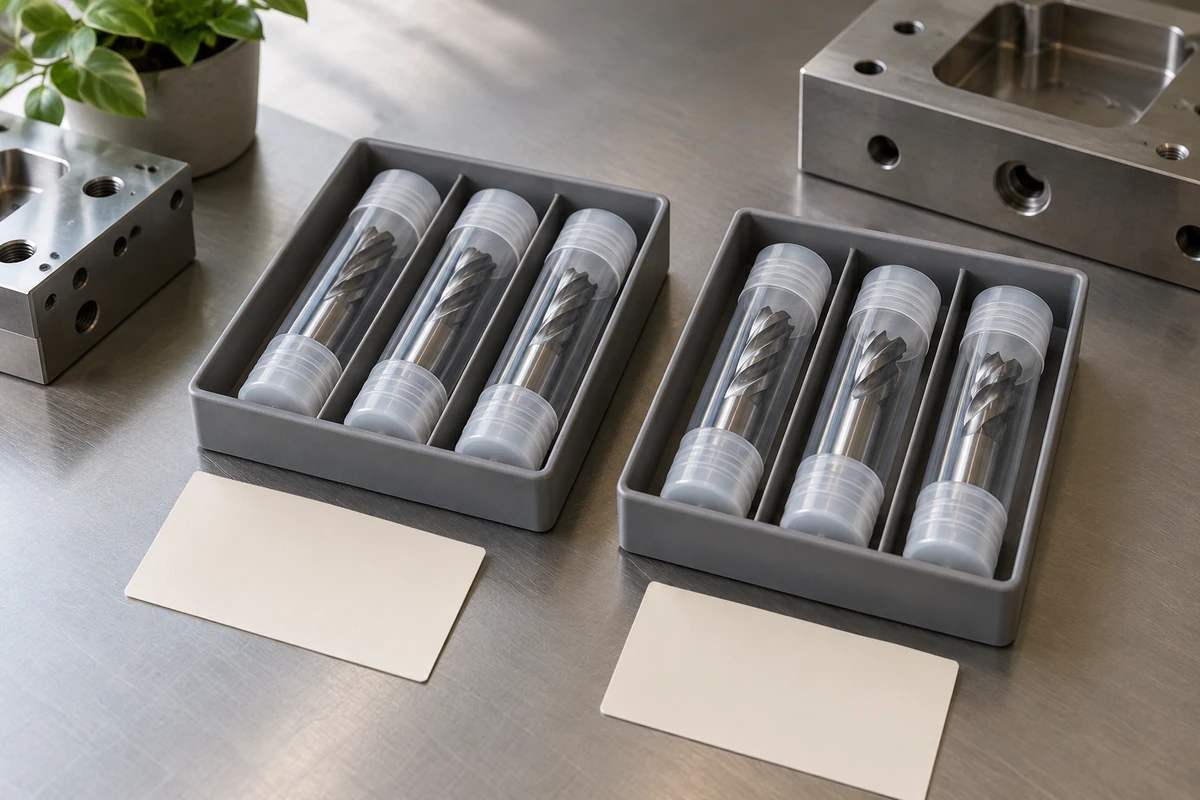
Before using returned, reconditioned cutters to reduce a new-tool purchase, establish what specification will come back and whether the tooling owner accepts those identified tools for the original requirement. Sending six worn tools for service does not establish six usable replacements. The service proposal may also use a different geometry or coating basis from the original maker’s specification.
OSG provides a useful, bounded example. Its regrind service page says competitor tools are processed using OSG geometry and coatings. Its end-mill section describes service for high-performance high-speed-steel and carbide end mills. That offering supports a precise question about the proposed returned specification; it does not establish acceptance, dimensions or stock eligibility for any actual worn tool. OSG regrind services
The buyer’s decision here is whether an identified service return may cover an existing new-cutter requirement. No real tools, service offer or technical approval have been supplied, and this article gives no grinding, tool-setting or machine-operation instructions.
Distinguish the original tool from the service basis
Record the original maker and complete cutter reference, together with the requirement the tool previously served. Preserve the source drawing or product reference where available. If the original identity is uncertain, say so before requesting service; a familiar diameter or sleeve color cannot recover the missing specification.
Then record the provider’s proposed restoration basis. OSG’s catalogue describes reconditioning its own tools using their original part drawings. That statement is explicitly about OSG tools. It should not be transferred to another manufacturer’s cutter simply because the same service provider receives it. OSG end-mill reconditioning, printed page 1560
For a competitor tool proposed for OSG service, ask what geometry and coating will be returned and how that proposal relates to the original reference. The published policy does not prove that every feature must change, or tell the buyer any numerical change. The provider’s actual response is needed to define the particular proposal.
This distinction matters before the buyer compares prices or reduces an order. A returned tool can retain its original history while needing a different post-service identity. Calling it “the same end mill” without explaining the service basis leaves the purchasing premise unclear.
Ask what the returned tool will be identified as
Request the proposed post-service specification and the evidence the provider expects to supply with the return. Ask how each tool or traceable group will be connected to that evidence. Keep the original maker code as history; do not use it alone as a claim that all original characteristics remain unchanged.
The tooling owner should identify which returned dimensions, geometry and coating information are necessary for its review. This is a request for an agreed deliverable, not permission for the buyer to invent tolerances or perform a measurement procedure. Where the provider cannot commit to a result until assessing the tool, retain that condition in the proposal.
Separate confirmed statements from alternatives. “Coating to be selected after assessment” is an open decision. “Original geometry where possible” still needs an explanation of the exceptions and the approval path. A general service brochure cannot supply the missing tool-specific answer.
The useful comparison is between the original requirement and the actual proposed result. If the tooling owner considers a changed tool suitable for a different application only, record that narrower scope. A useful returned tool need not qualify as replenishment of the original stock line.
Keep service candidates apart from accepted coverage
Use distinct quantity entries for tools proposed for service, tools accepted into the provider’s actual service scope, tools returned with attributable evidence, and tools accepted by the buyer for the identified requirement. These stages answer different questions and may cover different units.
Do not assume a published offering accepts every submitted tool or guarantees a returned quantity. Obtain the provider’s actual offer and conditions for the particular tools. OSG’s separate die-service discussion should not be borrowed to invent end-mill inspection, rejection or return terms.
Only the buyer’s authorized disposition can establish whether a documented return covers the original need. Procurement should keep unresolved candidates outside confirmed replacement coverage while showing their status to the decision-maker. That avoids hiding either the potential recovery or its uncertainty.
The following original worksheet focuses on this service-specific identity decision. It supplies no regrinding limit, acceptance tolerance or inventory formula.
| Entry | What to connect | Decision still needed |
|---|---|---|
| Original identity | Maker, complete cutter reference and original requirement | Missing original specification |
| Service candidates | Identified tools proposed for assessment or service | Actual provider acceptance |
| Proposed result | Geometry, coating and restoration basis | Differences not yet defined |
| Evidence on return | Agreed dimensions and identification deliverables | Scope or traceability gaps |
| Technical disposition | Accepted requirement, identified units and approver | Suitability unresolved |
| Purchase coverage | Accepted returns linked to the demand they can cover | New-tool purchase still required |
A service order number can connect records, but does not itself identify every returned unit. Ask the provider how its records distinguish partial returns, differing outcomes or tools processed under different approved proposals. Preserve those differences when the service result reaches stores.
A fictional six-tool reorder reduction
Imagine a buyer with six worn competitor end mills and a separate plan to buy six new tools to the original specification. The buyer requests OSG regrinding and considers canceling the new-tool request. The service proposal has not yet stated the returned geometry or coating. All quantities and events are fictional.
At this stage, the six worn tools are service candidates. The published competitor-tool policy makes the missing returned specification especially important. Ask for the proposed basis and have the responsible tooling owner compare it with the original requirement before treating the candidates as replacement coverage.
Suppose the provider later identifies a proposal for some tools while the others remain unresolved. Record the actual tools and conditions covered by that proposal. There is still no reason to infer that all six will return, that any return will arrive by the need date, or that a changed specification has been approved.
If identified returns are eventually documented and accepted for the original requirement, the buyer can consider the corresponding purchase revision under its own authority and existing commitments. If they are accepted only for another use, retain that separate identity and leave the original requirement visible. A service outcome should not rewrite a purchase specification through shorthand.
Carry the accepted identity into the next purchase
Preserve the original reference, actual service record, post-service specification and approval scope together. This lets the next buyer distinguish a new tool ordered to the original maker code from a reconditioned tool accepted under a particular disposition.
Ask whether the approval covers only the identified returns or establishes a separately approved recurring requirement. Do not silently extend a one-time acceptance to later service batches. A subsequent tool may have a different history or proposed result, so the evidence must remain linked to the actual service scope.
Keep controller tool numbers, pocket assignments, offsets and application settings outside this stock review. Any operational handover belongs with the responsible technical team. A purchasing identity record does not authorize editing machine data or returning a tool to operation.
As an independent buying agent, we can organize the service proposal and purchasing questions within an agreed scope; we do not perform reconditioning or approve technical suitability. Explore CNC cutters and end mills, then start a CNC quote request with an identified listing, description or images. The form accepts up to five PNG, JPEG, WebP or GIF images, limited to 10 MiB each and 20 MiB combined. Arrange drawings, PDFs and service reports through a separately authorized exchange.
Frequently asked questions
Does OSG regrinding preserve a competitor end mill’s original specification?
Do not assume it does. OSG states that competitor tools use OSG geometry and coatings. Ask for the proposed returned specification and obtain the tooling owner’s disposition for the identified requirement.
Can six tools sent for reconditioning replace a six-tool purchase?
Sending six tools establishes a proposed service quantity, not six accepted replacements. Keep provider acceptance, documented returns and buyer-approved coverage separate until the actual results are known.
What identity should be retained for a reconditioned cutter?
Keep its original maker and code as history, alongside the actual service reference, documented post-service specification and approval scope. Do not use the original code alone to imply unchanged characteristics.
Does an accepted service return authorize canceling a new-tool order?
No. The accepted result informs a separate purchasing decision. Any revision must follow the buyer’s authority and existing commitments, with unresolved quantity and timing still visible.
Sources
Discuss a sourcing request related to this article.Can a Reconditioned Cutter Replenish the Original Tool Stock?