
ATC tool holder RFQ: specify the complete interface
Quote ATC holders for the identified spindle and rack. Compare complete interfaces, retention items and included accessories before ordering.
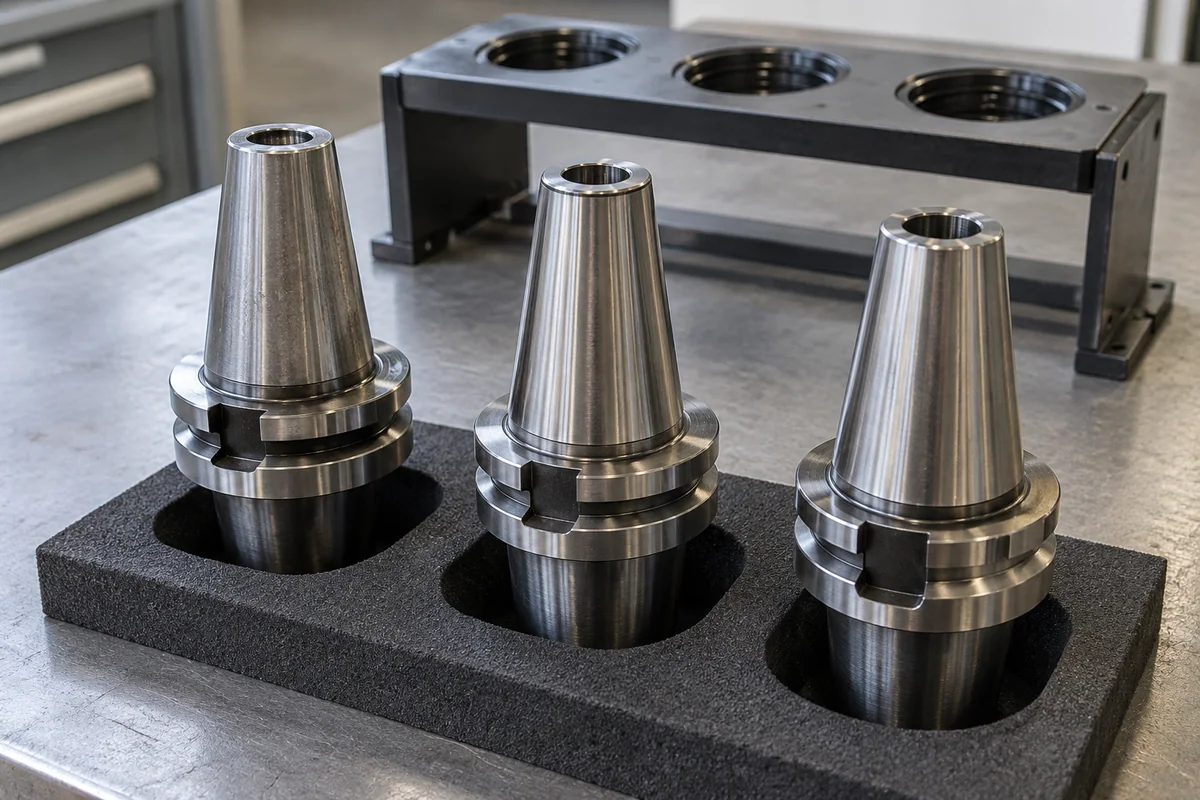
Order ATC holders against the exact selected spindle and changer. A shared taper label does not settle retention, rack handling or included accessories; ask for a documented combination and an itemized offer.
Compare a complete assembly with loose components
An inexpensive holder listing can exclude the retention item, collet, nut or rack component expected by the buyer. Do not reconstruct a complete system price by assuming those omissions are standard. Ask the supplier to mark every line as included, separately priced, buyer-supplied or unresolved.
| Offer line | Description to retain | Purchase decision |
|---|---|---|
| Holder | Exact code and machine-side drawing | Is it the documented candidate? |
| Retention item, where required | Exact supplied item and approved reference | Is this combination supported? |
| Tool-side accessories | Designation, range and quantity actually offered | Complete assembly or components only? |
| Rack-related item | Existing supported component or proposed change | Does the integration scope change? |
A supplier may legitimately quote only loose holders. That offer should remain labelled that way rather than being compared with a complete tooling package. For a starter batch, request the minimum quantity for each approved variant rather than treating a mixed promotional set as the needed assortment.
Record who answers the spindle, holder and rack questions when several sellers are involved. The independent agent can coordinate those answers; it cannot supply missing manufacturer approval. Ask about the handling of a wrong supplied code and the evidence required for a return before paying international freight. This is a purchasing comparison, not permission to insert or cycle an unverified assembly.
This decision is narrower than choosing an ATC system. It asks which documented holder combination is approved for the spindle and changer already selected. It does not reopen the system’s payback calculation, authorize a retrofit or establish that a tool shank is correctly gripped.
Anchor the order to the installed or selected system
Record the machine, spindle and changer or rack models, including the relevant configuration and revision. Use the manufacturer’s documentation for the intended system. A spare holder borrowed from another machine can be an identification clue, but it is not the authority for what the new machine accepts.
Ask the spindle or machine supplier to identify the complete holder-interface designation and the approved drawing or ordering reference. If a marketplace listing uses a shortened label, require the seller to resolve it to the exact offered item. Do not infer the missing suffix, retention detail or changer interface from a similar-looking picture.
Where the machine has not yet been selected, pause the spare-holder choice at the proposal stage. Buying a large holder set before the system is defined can leave the buyer with tooling that no selected supplier has agreed to support. The complete tool-changer purchase guide covers the wider system decision.
Split the holder’s connections into separate questions
The spindle-side interface and the tool-side interface should not be collapsed into one product name. A holder may be described prominently by its tool-side collet system while the machine connection remains unclear. A cutter-shank purchase decision cannot resolve that missing machine interface.
Use a short interface schedule for the proposed combination:
| Connection or item | Ask for | Who should resolve an ambiguity? |
|---|---|---|
| Spindle to holder | Complete interface designation and exact holder drawing | Spindle or machine manufacturer |
| Retention arrangement | Required retention part, if applicable, with exact identity and drawing | Spindle manufacturer or authorized technical provider |
| Changer or rack to holder | Approved holder geometry and compatible pocket, fork or rack reference | Changer/rack supplier and integration owner |
| Holder to tooling | Exact tool-side interface and included accessories | Holder/tooling supplier |
| Complete supplied item | Holder, retention component and accessory part numbers with quantities | Quoting supplier |
The table asks for identification; it does not prescribe a retention mechanism. Follow the documentation for the exact interface. Do not assume that every ATC holder uses the same kind of separate pull stud, or that a stud supplied in the box is approved for the spindle.
Use the retention reference, not a resemblance
Haas’s toolholder and pull-stud reference specifically identifies incorrect taper size and incorrect pull-stud size or type as problems. It also directs readers to machine-specific layout information. That supports an exact-identification approach to the purchasing inquiry; it does not establish compatibility between Haas tooling and an unrelated spindle. Haas toolholder and pull-stud specifications, RD0074.
For a system that specifies a separate retention part, have the supplier state its exact manufacturer and part number. Request the drawing or approved reference from the spindle side as well as the holder side. A seller saying that a part threads into the holder does not, by itself, answer the spindle-retention question.
Keep any proposed substitution visible. Ask which manufacturer has approved the combination and what document supports that response. Do not provide substitute dimensions, machine a different retention shape or treat “same taper” as approval to mix an undocumented retention component into the order.
Make the rack interface part of the holder purchase
The order should identify the changer or rack that will handle the holders. Request its supported holder references and any applicable geometry or accessory requirements. Let the responsible integrator compare the proposed holder with that documentation rather than relying on a photograph of it resting in a fork.
If the supplier offers replacement rack components with the holder set, list them as distinct items. Ask whether those components preserve the already approved system or form a changed configuration. Do not call a new fork or rack arrangement a routine accessory when it changes the integration being accepted.
Also request the manufacturer’s limits relevant to the intended complete tool assemblies and the changer. This article does not supply values for tool mass, diameter, length, speed or balance. Those requirements must come from the actual system documentation and technical review, not a generic holder listing.
A fictional comparison with the same broad taper label
Suppose a fictional buyer has selected spindle system S and rack R. Two offers use the same broad taper label. Offer A names holder H-A and includes an unidentified retention component. Offer B names holder H-B and retention part P-B, but does not state whether the holder is supported by rack R.
Neither offer is ready for approval. A needs the retention identity and the relevant combination confirmation. B provides a better-defined spindle-side proposal, yet its rack question remains open. The buyer should not interpret the shared taper label as resolving either gap.
Now suppose the spindle supplier identifies P-B as an approved part for the proposed holder combination, while the rack provider says H-B needs a different rack component. The resulting choice is explicit: request a holder supported by the existing rack, or ask the responsible integrator to evaluate the changed rack proposal. Buying the revised rack hardware is not automatically covered by approval of the original holder inquiry.
This example is fictional and establishes no actual brand compatibility. Its point is that a clear part number makes a question answerable; it does not make every related interface acceptable.
Agree what the price includes
Ask for quantities by complete holder identifier and tool-side configuration. Separate retention parts, collets, nuts and other accessories where relevant. State whether the buyer wants complete documented assemblies or individual replacement components. A quoted “holder set” should resolve to a specific list rather than an assortment shown only in a photograph.
Where documented coolant-related options or other system variants are relevant, have the supplier identify the exact selected version and its approved combination. Keep those choices in the quotation instead of assuming every holder with the same outline carries the same features.
For repeat orders, preserve the item identifiers and combination references. If the seller replaces a retention part or holder model, review that change before purchase even if the marketplace title remains unchanged.
Verify receipt without overstating the evidence
Agree how the supplied items and documentation will be identified at receipt. Packaging, markings, quantities and apparent damage can be recorded photographically. Such evidence cannot prove retention performance, dimensional conformity, balance or reliable automatic handling.
If technical inspection or a change-cycle evaluation is required, define it with the responsible provider for the exact configuration. Do not use an improvised insertion or tool-change attempt to settle an unresolved interface question. Purchase documentation should make the question clear before any evaluation is commissioned.
Send the exact-system inquiry
A useful request reads: “Please quote holders for our identified spindle and changer/rack configuration. Name the exact holder interface, required retention arrangement and compatible rack reference. List all included components and provide the manufacturer documentation supporting the proposed combination. Mark every substitution or unresolved interface separately for approval.”
Start with CNC spindle sourcing and send the listing or requirement through the CNC quote form. We are an independent buying agent, not the holder manufacturer or the authority approving a machine integration.
AI-assisted editorial update, 26 October 2026. Sources and bilingual wording were checked with AI assistance; technical acceptance remains with the responsible provider.
Frequently asked questions
Does the same taper name establish compatibility?
No. The exact spindle, retention arrangement, holder geometry and changer interface still need their applicable documented review.
Must every ATC holder have a separate pull stud?
Do not assume that. Identify the actual retention design from the selected system documentation.
Can visual warehouse checks approve the combination?
They can record item identity, quantity and visible condition. Technical interface conformity and reliable handling require separately agreed evidence.
Sources
Discuss a sourcing request related to this article.ATC tool holder RFQ: specify the complete interface
Prepare a clearer buying request
Keep this page as context. Add what you know; review everything before sending. No purchase is made at this step.
Edit the checklist below before continuing. It stays a planning note; it does not approve a product or order.
- Spindle to holder
- Retention arrangement
- Changer or rack to holder
- Holder to tooling
- Complete supplied item