
Record Cutter Edge Damage Before a New Tool Is Used
Preserve a new cutter’s as-received condition, distinguish designed edge features from suspected damage, and ask for an attributable technical disposition.
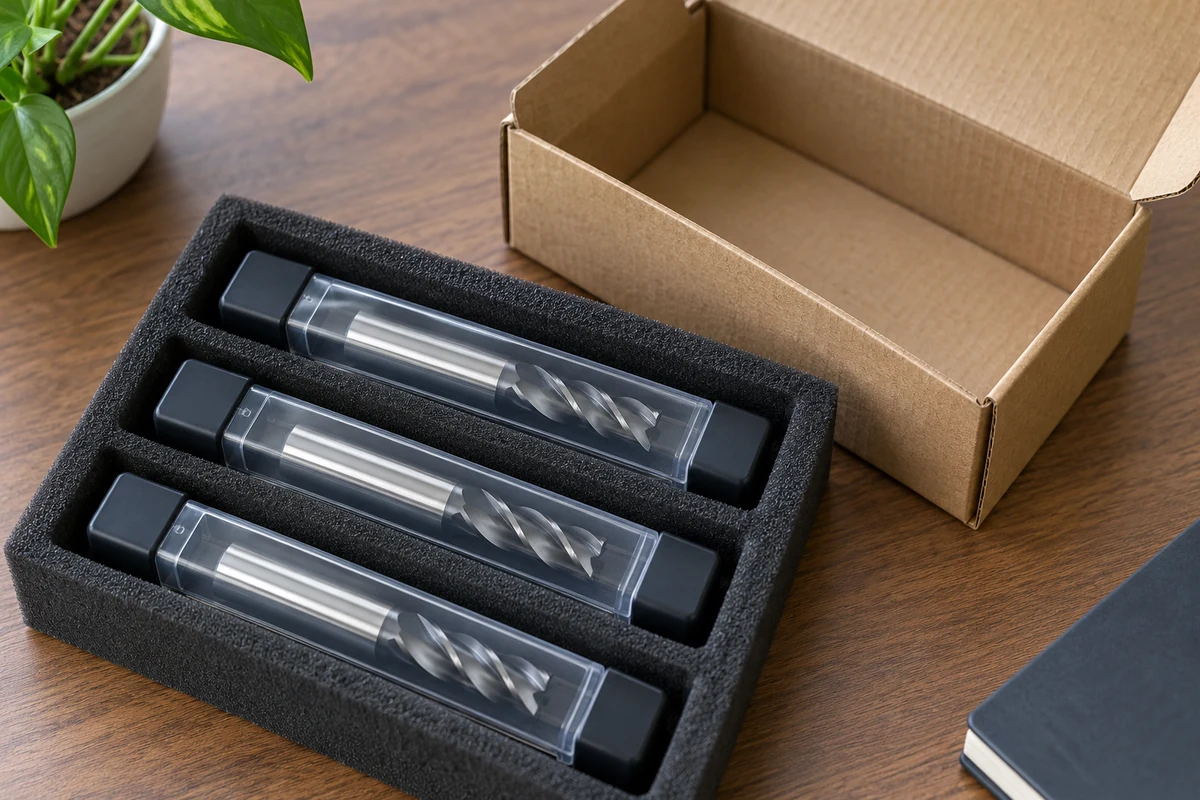
If a new cutter appears chipped before use, preserve its protected arrival state and open a specific condition query. Identify the tool, package and observed edge location before asking the seller to resolve it. A trial cut changes the history you are trying to document and is not a substitute for a qualified review of suspected arrival damage.
This receiving decision concerns the condition of an identified cutting edge. It does not choose feeds, speeds, flute geometry or a coating, and it does not establish a universal acceptable chip size. The applicable toolmaker information and agreed purchase criteria must guide the disposition.
Compare the edge with the exact intended geometry
A discontinuous edge is not automatically a broken edge. Harvey Performance explains that chipbreaker end mills intentionally use notch profiles that create a serrated cutting edge. The comparison therefore needs the exact tool design, not an assumption that every new end mill should have a continuous-looking edge. Harvey Performance on chipbreaker tooling
Request the full manufacturer part number and the corresponding product drawing or geometry description. Preserve any corner-radius, corner-chamfer or chipbreaker designation already included in the order. A family image showing another tool option is weak comparison evidence when the disputed location is precisely where those options differ.
Describe what is visible before naming its cause. “Local interruption at the corner shown in image E-03” is a reviewable observation. “Transport fracture caused by bad packing” combines a diagnosis with an allocation of responsibility that an arrival image may not support. Keep the observed feature, technical classification and commercial cause as separate questions.
Likewise, a regular pattern elsewhere on the cutter does not clear one isolated irregularity. Ask the specialist whether the identified location agrees with the intended geometry of this part. If the available view cannot resolve that question, record it as unresolved rather than accepting or rejecting the tool by appearance alone.
Protect the evidence without creating a handling exercise
Use the protected views and accessible markings available through the supplier’s packaging where practical. Keep the package-to-tool relationship intact, and retain the original image files. Do not ask receiving staff to touch a cutting edge, force open a damaged holder or remove protective material solely to satisfy a photograph checklist.
Where the required feature cannot be seen safely, ask the seller or competent tooling provider for an agreed assessment arrangement. Any closer examination should have an identified owner, method and output. This article supplies the questions for that arrangement, not instructions for handling sharp tools or operating inspection equipment.
Record when the concern was first noticed and what had happened to the tool by that time. Distinguish an unopened arrival observation from an observation after unpacking, mounting or use. If an action already occurred, state it honestly. Reconstructing a cleaner history makes the evidence less useful to every party.
Keep arrival condition separate from wear diagnosis
Harvey Performance’s end-mill troubleshooting guide discusses edge chipping arising during machining. Its existence illustrates why a post-cut photograph answers a different history question from a pre-use photograph. It does not identify the cause of a mark on a delivered cutter or establish that any specific new tool is damaged. Harvey Performance end-mill troubleshooting guide
Ask for a technical classification of the observed feature before debating an operating remedy. A suggestion to change cutting settings does not explain a feature documented before the cutter entered service. Conversely, when the first evidence was recorded after use, avoid asserting that the condition definitely existed on arrival.
Do not sharpen, polish, clean away deposits or conduct a cutting trial to make the discrepancy disappear. Those are changes to the item’s condition, not neutral documentary clarification. If repair or evaluation is proposed, have the responsible parties agree the scope and preserve the existing evidence before any authorized work.
Build a tool-specific condition record
Use one observation row per identified tool and disputed location. Multiple photographs of the same location belong to that row; a second tool needs its own identity even when its package looks identical. This original editorial method is intended to make an evidence request precise, not to define an inspection standard.
| Record field | Useful entry | Limit to retain |
|---|---|---|
| Tool and package | Ordered part number, observed markings and package reference | A stock photograph does not identify the delivered tool |
| Observation | Visible location and original image reference | Appearance is not a cause diagnosis |
| Geometry reference | Exact toolmaker drawing or description | Another cutter option may have a different edge |
| History | First observation and disclosed intervening actions | Unknown history remains unknown |
| Coverage | Tools observed and tools not assessed | One concern does not establish the whole lot’s condition |
| Disposition | Named reviewer, conclusion, scope and response reference | Seller reassurance alone is not the buyer’s acceptance |
If microscopy or dimensional assessment is required, ask the competent provider to define the applicable method and decision criteria. Do not invent a magnification, edge-defect threshold or sampling rule. A technically impressive image still needs to be linked to the actual tool and the agreed question.
Work through a fictional protected-tool discrepancy
Imagine a fictional shipment of eight individually sleeved cutters. One sleeve, P-06, shows a local corner interruption through its clear wall. The order identifies a particular chipbreaker tool, and the buyer has an image of its intended recurring notch pattern. The receiving observer has not opened P-06 or used the cutter. These quantities and references are invented.
The first entry records P-06, the ordered code, the accessible label and the location visible in the original arrival image. It does not call all eight tools defective. The other seven remain under their actual recorded review status; no conclusion is manufactured for tools whose edges have not been assessed.
The supplier initially replies that the notches are normal chipbreakers. The buyer should preserve that response and ask a narrower question: does the particular corner interruption on P-06 correspond to the manufacturer’s intended geometry? A generic explanation of the repeating flute notches does not resolve an independently identified corner concern.
Suppose a qualified reviewer later confirms that the view through the sleeve is insufficient to classify that corner. The next step is an agreed protected assessment or return arrangement, not an improvised cutting trial. If the reviewer instead confirms a departure from the ordered condition, document that conclusion against P-06 and follow the authorized remedy process.
A replacement would receive a new arrival record linked to the original discrepancy. Its receipt closes neither the original evidence record nor the replacement’s acceptance automatically. Keep the seller’s remedy, the replacement identity and the technical disposition as connected but distinct entries.
Ask for a usable answer and a bounded release
Send the seller the exact product reference, relevant protected images, first-observation history and the unresolved geometry question. Ask who can provide the technical response and what additional evidence is required. A reply should identify the item it covers and the basis for treating the feature as intended geometry, a discrepancy or still unresolved.
If the order did not define an edge-condition criterion, say so. The buyer and technical owner must decide how the current concern will be assessed; receiving staff should not invent a retrospective acceptance limit. Any accepted deviation should name the affected tools and stay separate from future order requirements.
We act as an independent buying agent and can coordinate supplier questions and records. Technical assessment of a cutting edge needs an agreed competent provider. The CNC cutters and end mills category gives broader sourcing context.
Use the CNC quote form for a supported product link, description or product images. It accepts up to five PNG, JPEG, WebP or GIF images, limited to 10 MiB each and 20 MiB total. Mention any technical report or drawing that needs a separate authorized exchange; the image field is not a PDF, CAD or ZIP upload channel.
Frequently asked questions
Does a notched cutting edge mean the tool arrived damaged?
Not necessarily. Some chipbreaker tools deliberately have notched edges. Compare the exact toolmaker geometry with the specific observed location and obtain a competent assessment if it remains ambiguous.
Should I try one cut to settle an arrival-condition dispute?
A cutting trial changes the tool’s history and does not replace assessment of the documented pre-use concern. Agree the technical review or remedy before changing the condition.
Does one suspect cutter mean the entire shipment is defective?
Record the affected tool and actual coverage. One observation does not establish the condition of unassessed tools; any broader inspection scope needs a responsible decision.
What if the edge cannot be seen through its sleeve?
Record that limitation and request an agreed assessment arrangement. Do not expose or handle a sharp edge simply to complete a photograph request.
Sources
Discuss a sourcing request related to this article.Record Cutter Edge Damage Before a New Tool Is Used