
Keep Rail-Hole Cap Families Separate in a Repeat Order
Preserve the existing THK rail-hole cap family and exact rail identity before combining replacement quantities or accepting a C-to-CV proposal.
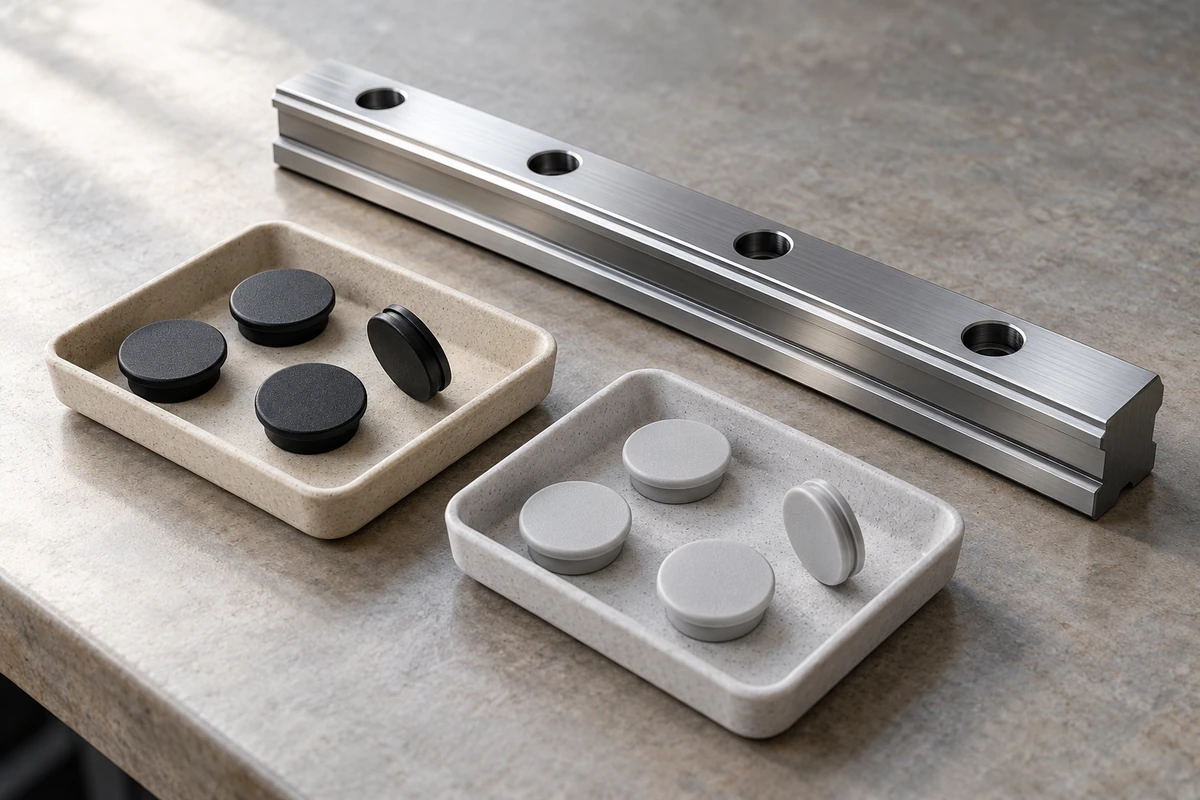
Keep the existing cap family in a rail-hole cap reorder, even when two bags carry the same nominal size. THK’s LM Guide FAQ distinguishes C caps, which it says can be replaced with CV caps, from GC caps, which cannot be replaced with CV because the mounting holes have a special shape. That manufacturer-specific distinction is enough to question a combined “same-size caps” purchase. THK C, GC and CV cap FAQ
For the actual order, identify the rail and existing cap, then request the applicable proposed cap designation and supporting drawing or manufacturer response. The FAQ does not select a code for an unidentified rail. This article addresses protective mounting-hole caps; it does not establish interchangeability of load-bearing rails and blocks or provide a fitting procedure.
Give each existing cap family a traceable rail reference
Retrieve the machine parts record, rail designation and prior cap purchase where available. Keep the manufacturer, complete cap designation and rail reference together. A general store description such as “rail plugs” makes it difficult to determine which earlier requirement a replacement proposal is answering.
Record the source of the cap identity. An original order line, a manufacturer’s response and a label photograph provide different evidence. A handwritten bin name may be useful as a location reference, but it should not overwrite the product designation in the original documentation.
If caps were supplied with a guide assembly, ask which exact accessory was included. If a later purchase changed the cap family, retain that history rather than assuming the original assembly paperwork describes the current requirement. State where the identity is uncertain; neither the age of a record nor the appearance of a cap settles it.
Use accessible records and existing images. A purchasing inquiry should not require removing installed caps, measuring a concealed opening or trying an unknown part in the rail. The responsible technical provider should define any further assessment required to establish applicability.
Read the C-to-CV statement within its stated boundary
The manufacturer FAQ answers a particular family-replacement question. Preserve its distinction when requesting a quote: a documented C application and a documented GC application should not be sent as one undifferentiated requirement for CV caps.
Ask the supplier to identify which installed rail and existing cap its proposed replacement covers. Retain the exact product designation and applicable manufacturer reference. A quotation that repeats only the nominal rail size leaves the cap and mounting-hole question unresolved.
Do not extend the cited statement into every direction of substitution. It does not establish universal two-way equivalence among C, GC and CV, approve another manufacturer’s cap or show that every nominal-size option shares the same geometry. Those would require their own applicable evidence.
Where a supplier proposes an alternative, ask the relevant manufacturer or competent technical reviewer to resolve that exact proposal. Keep the purchasing request narrow enough that the answer can identify the covered rail and cap, rather than endorsing an entire mixed inventory under one familiar family name.
Preserve the family distinction in the quote
List each identified rail/cap requirement on its own line. Include the existing cap designation, proposed designation, required quantity and source of applicability evidence. An exact-match repeat and a proposed family change should remain distinguishable in the supplier’s response.
Ask what the seller means by its selling unit. A packet count describes the commercial package, while the requested cap quantity describes the buyer’s need. Preserve both without assuming a standard pack size. If different family lines use different selling units, a combined quantity can hide a change in the contents being purchased.
A lower price for one consolidated line is not evidence that the technical requirements have converged. Ask the seller to restore the separate identities before deciding whether a combined commercial offer is meaningful. The eventual purchase may use one supplier while retaining several distinct line items.
| Reorder field | Evidence to retain | Question left open by a generic label |
|---|---|---|
| Installed rail | Manufacturer and complete rail reference | Which mounting-hole application is involved? |
| Existing cap | Full designation and source record | Is the recorded family C, GC or unresolved? |
| Proposed replacement | Exact cap designation and maker | What product would actually be supplied? |
| Applicability | Relevant drawing or attributable manufacturer response | Does the proposal cover this rail and cap? |
| Quantity and selling unit | Required caps and stated pack contents separately | Does a “bag” or “set” have defined contents? |
| Purchasing decision | Exact-match repeat, proposed change or unanswered | Has a family change actually been accepted? |
This worksheet is an original purchasing aid. It creates no fitting tolerance, inspection standard or permission to substitute a component.
Resolve a fictional mixed-bin request
Imagine two fictional machine records refer to different THK cap families. Machine A’s record names C, while Machine B’s names GC. Stores has combined their cap bags under one nominal-size label, and a buyer asks a seller to quote CV caps for the combined requirement. No real machines, stock quantities or cap codes are represented.
The first useful action is to preserve the two documentary identities in the inquiry. The generic bin label cannot establish that either bag is suitable for both machines. Ask which records and labels can be connected to each bag, leaving any untraceable quantity unresolved.
For Machine A, request the exact proposed CV designation and its application evidence. For Machine B, retain the GC requirement and ask for the supported supply option rather than treating the CV proposal as a shared answer. A response covering one machine does not close the other line.
Suppose the seller returns only “same size, both fit.” Keep that statement as its proposal and request the missing family-specific evidence. Do not resolve the disagreement through an improvised physical trial, by relabeling unknown caps or by counting the entire mixed quantity as an approved replacement pool.
If later documentation resolves one bag’s identity, update that bag’s record within the actual evidence. Any remaining uncertainty stays visible. The example ends with separately reviewable purchase lines, not a claimed compatibility result or a recommendation to buy extra caps as a precaution.
Carry the accepted cap identity into the next repeat
Once the responsible reviewer has accepted an exact replacement proposal, retain the covered rail, existing family, approved new designation and supporting reference with the order. If the approval is limited to one application, preserve that limit. Do not broaden it to every machine using the same nominal rail size.
Ask the supplier to identify changes in the product offered on a subsequent repeat. A reused listing photograph or shortened invoice description can make a family change easy to miss. Compare the actual designation against the accepted cap line, rather than assuming that the marketplace URL defines the product indefinitely.
Delivered label and contents photographs can help connect the received package to the ordered item. They do not establish mounting-hole geometry, physical fit or machine performance. Any technical inspection or fitting work requires a separately defined scope and competent personnel.
Send a family-specific inquiry
The completed inquiry should make it possible to answer one practical question for each line: which exact cap is proposed for which documented rail application? Keep stock availability, pack quantity and timing tied to the seller’s current offer. The manufacturer’s family FAQ supplies none of those commercial commitments.
As an independent buying agent, we can collect the seller’s item details and organize the evidence for approval. See CNC linear-motion components for sourcing context. Use the CNC quote request for a supported marketplace link, a description or existing images of the relevant product records.
The form supports up to five PNG, JPEG, WebP or GIF images, limited to 10 MiB each and 20 MiB total. CAD, PDF and ZIP files need a separately authorized exchange; they are not supported by its image field.
Frequently asked questions
Can THK GC caps be replaced with CV caps?
The cited THK FAQ says GC caps cannot be replaced with CV caps because their rail mounting holes have a special shape. Identify the actual rail and ask for its supported cap proposal.
Does THK allow C caps to be replaced with CV caps?
The cited FAQ says yes for that family-replacement question. The order still needs the exact rail application, proposed cap designation and applicable supporting documentation; the statement does not select an unnamed part.
Can two cap bags with the same nominal size share one stock identity?
Keep their documented families and rail applications separate unless the relevant evidence supports the proposed use. A generic size label does not resolve a missing C, GC or CV identity.
Should I test a cap in the rail to settle an unclear listing?
This purchasing method calls for the exact item records and manufacturer applicability evidence. It provides no physical trial, removal or insertion procedure; any necessary assessment belongs to an appropriately scoped technical provider.
Sources
Discuss a sourcing request related to this article.Keep Rail-Hole Cap Families Separate in a Repeat Order