
Review Thread Inspection Evidence for a Delivered Clamp Kit
Match delivered clamp studs and nuts to the specified thread, inspection method, gauge records and actual coverage before accepting a kit-wide pass.
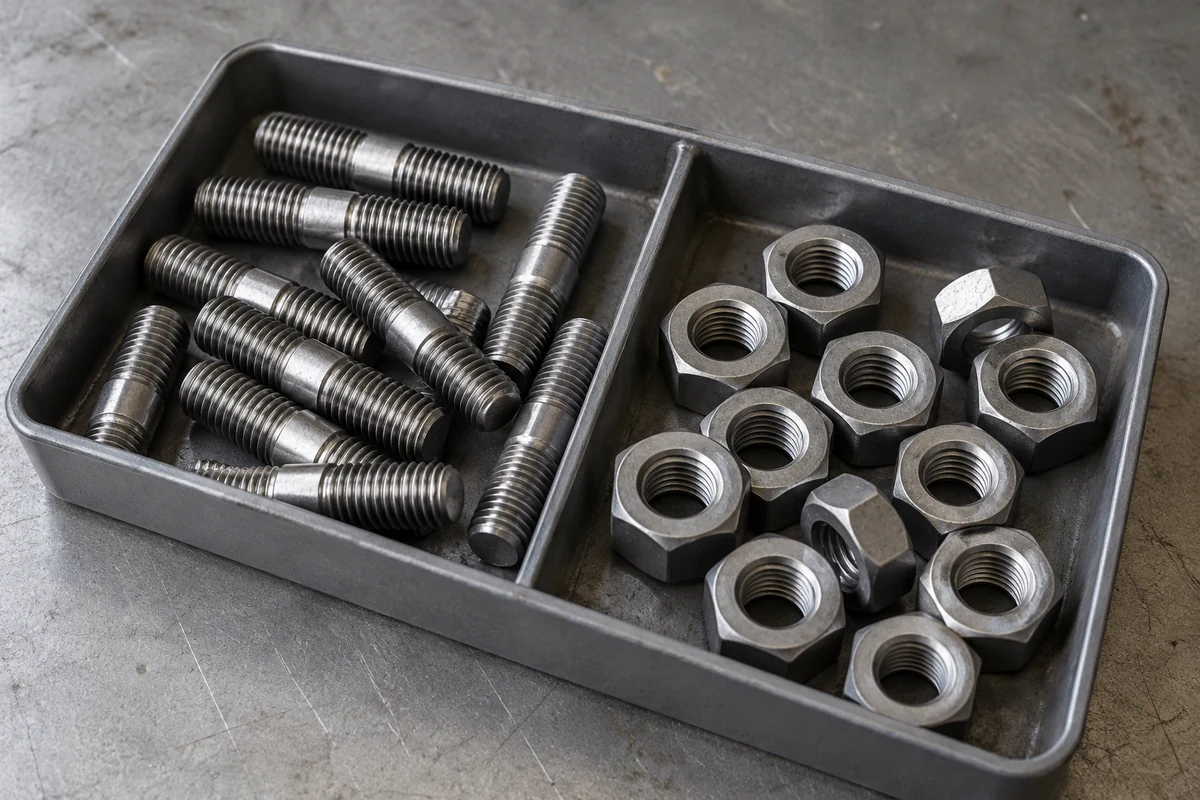
A delivered clamp kit needs thread evidence that identifies the studs and nuts actually checked, the specified thread, and what the inspection covered. A video of several nuts turning onto one stud answers a narrower assembly question. It does not supply a missing inspection result for every threaded component in the kit.
Begin with the inspection requirement accepted for this order. The practical receiving decision is whether the returned records answer that requirement, or whether the affected components need further review. This article concerns thread-conformity evidence. It does not approve clamp loads, tightening, table compatibility or the safety of a workholding setup.
Recover the thread requirement before reading “passed”
Find the released stud and nut specifications, including their revisions. Retain the full thread designation and any specified class, handedness and thread form. Use the order’s actual information; do not fill gaps from a similar kit’s catalogue or from the diameter printed in a marketplace title. If the designation was never resolved, ask the responsible technical owner to settle it before interpreting inspection results.
Separate the external threads on studs from the internal threads in nuts, including T-nuts where they are part of the accepted scope. Identify each component family, stud length and delivered lot or package reference. Similar-looking nuts can belong to different order lines, and a result labelled only “clamping set” leaves the inspected population uncertain.
Vermont Gage’s thread-gage overview identifies pitch diameter and functional thread as inspection subjects and says its plug-gage assemblies carry thread size, class of fit and pitch-diameter markings. Those fields illustrate why “checked with a thread gauge” is incomplete identification. They are not specifications for the buyer’s unnamed clamp kit. Vermont Gage thread-gage overview
Ask which thread characteristic the evidence addresses
A dimensional result and a functional thread result should retain their own descriptions. Vermont Gage states that its thread-measuring wires measure the simple pitch diameter of externally threaded parts. A wire-measurement report therefore should not be relabelled as evidence that every agreed functional-thread check was completed. Ask the metrology reviewer how the recorded method maps to the requirement. Vermont Gage measuring wires
Conversely, a reported gauge outcome should remain a gauge outcome unless the report also provides a measured value. Do not invent a pitch-diameter reading from the word “pass.” Preserve the characteristic, method reference and result type so the reviewer can distinguish what was checked from what the buyer hoped had been checked.
If the specification calls for additional thread characteristics, request their corresponding evidence. Do not assume that one method covers every requirement simply because the parts assemble. The inspector should explain method coverage and limitations, including any features omitted. This is a request for a reviewable report, not a set of gauge-use instructions.
Connect the gauge record to the inspection event
Ask the provider to identify the gauge or measuring equipment used, its applicable designation, the inspection date and the supporting status records required by the agreed quality plan. A photograph of a gauge without its relationship to the inspected parts does not establish which kit it was used on. A current certificate attached after delivery also needs a clear connection to the original inspection event.
Certificate titles deserve particular care. Vermont Gage’s working-thread-plug page distinguishes an included certificate of accuracy from separately purchasable accredited and non-accredited calibration certificates. That is a specific manufacturer’s document distinction, not proof of what accompanied another provider’s equipment. Request the actual document required for this inspection rather than treating the word “certificate” as interchangeable with every other evidence type. Vermont Gage working thread plug gages
The qualified reviewer decides whether the identified method and equipment records are adequate. Purchasing can check that the identifiers match and that missing records are requested. Neither the equipment certificate nor an accreditation logo supplies the absent results for the delivered studs and nuts.
Make coverage visible by component
Build the receiving record around component populations, rather than the advertised piece count. Washers and storage accessories should not inflate the apparent coverage of threaded parts. Where the approved plan uses sampling, retain its reference and the actual selection; where complete inspection was agreed, request evidence for that agreed extent. Do not create a sampling rule after seeing the results.
| Record field | Thread-specific question |
|---|---|
| Kit line and component | Which stud length, nut type or T-nut identifier does this result concern? |
| Governing designation | Which released thread specification and revision were applied? |
| Characteristic and method | Is this a functional check, a reported dimension or another named inspection? |
| Equipment reference | Can the gauge or instrument be linked to the applicable status record? |
| Covered population | Which delivered pieces, lots and threaded regions are represented? |
| Result and disposition | What was reported, what remains unresolved and who may accept it? |
For a stud with separately specified threaded regions, ask whether the report identifies the regions covered. For different nut types, keep their results separate even when they share a nominal thread designation. This avoids silently extending one documented observation across components that the report never names.
Work through a fictional kit discrepancy
Imagine a fictional order containing twelve studs in three length groups and twenty-four nuts in two identified types. Its approved inspection plan calls for separate results for the listed stud and nut populations against the released thread specifications. The supplier returns a clip showing all twenty-four nuts being fitted to one short stud and labels the entire kit “thread checked.” These quantities and events are invented for this example.
The clip can be retained as an assembly demonstration involving the shown components. The receiving record should still show that the agreed inspection method, applicable gauge identity and results for the other stud groups are not reported. It should not label those groups defective: the available evidence has not established their conformity either way.
Ask the report author to supply the original inspection records and explain the clip’s scope. Suppose the reply includes a simple pitch-diameter measurement for the demonstrated stud. That adds a specific dimensional result for one identified item; it does not automatically close the required functional checks or expand coverage to the other eleven studs.
Suppose a later report identifies the correct specifications, methods and covered pieces but notes that one nut type was excluded. The report may now explain the gap clearly, yet the excluded population remains open. Have the authorized reviewer decide the required next step. Any newly commissioned inspection needs an agreed scope and competent provider; the buying team should not prescribe an improvised trial fit.
Close the thread decision without approving the whole setup
A useful closure names the component population, requirement revision, reviewed results and decision owner. Retain any restrictions and the reason an item remains unresolved. If a replacement nut or stud arrives, link its identity to the replacement evidence rather than copying the first kit’s result onto it.
Our role is an independent buying agent: we can organize component descriptions and supplier questions for review. Inspection availability and technical acceptance need their own agreement. For category context, see CNC workholding. A completed thread record still leaves material properties, table interfaces and actual holding arrangements to their respective reviews.
Use the CNC quote form for a supported listing link, description or initial images. It accepts up to five PNG, JPEG, WebP or GIF images, limited to 10 MiB each and 20 MiB total. Mention inspection reports or drawings that need a separately authorized exchange; the image field does not accept PDF, CAD or ZIP files.
Frequently asked questions
Does a successful nut-to-stud trial fit complete thread acceptance?
It only supports the demonstrated combination and conditions. Compare the returned evidence with the approved thread-inspection requirement and ask the responsible reviewer what remains unestablished.
Can a measured pitch diameter replace every functional thread check?
Do not assume that equivalence. Preserve the reported characteristic and method, then have the metrology reviewer determine whether the evidence covers the actual requirement.
Does a gauge certificate prove the delivered clamp kit passed?
A gauge record concerns the identified equipment. The kit still needs attributable inspection results for the agreed component population and a qualified acceptance decision.
How should results for several stud lengths and nut types be recorded?
Identify each component group and its covered pieces or authorized sampling basis. Keep exclusions and any separately specified threaded regions visible rather than extending one result to the whole kit.
Sources
Discuss a sourcing request related to this article.Review Thread Inspection Evidence for a Delivered Clamp Kit