
Handle Linear-Guide Preservation Concerns at Receipt
Preserve a delivered linear guide’s observed condition and obtain manufacturer-specific advice when packaging, contamination or surface marks raise a concern.
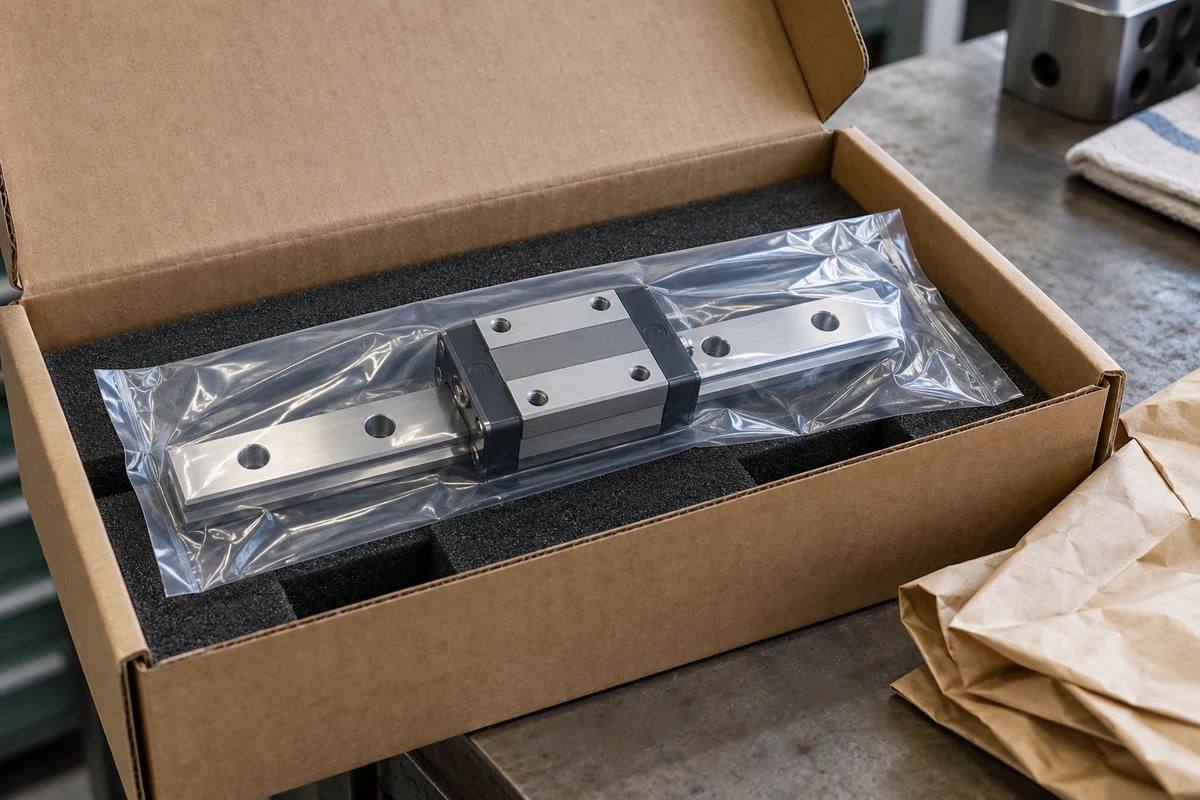
A torn protective wrap or unexplained mark on a delivered linear guide calls for a preservation review before installation or use. Record the guide identity, affected location and packaging state, then ask the responsible manufacturer or technical provider what the evidence means for that exact assembly. A clean-looking photograph cannot establish acceptable running condition or remaining life.
The receiving question is narrower than whether a rail and block fit the machine. It concerns what happened to the protected guide, what is actually visible now and which competent decision is needed before its condition is accepted. This article does not provide cleaning, lubrication, block-removal or motion-test instructions.
Distinguish preservation from readiness to run
THK’s LM Guide manual treats lubrication and storage as separate subjects. It distinguishes anti-rust oil from the lubricant needed before use, and warns that lubricant may deteriorate during extended storage. These are reasons to request the applicable preservation and commissioning information, not to infer operating readiness from an oily surface. THK LM Guide manual, sections 2-4 and 2-5
Ask what protection was specified for the delivered guide and what the supplier actually applied or supplied. Record the stated product and manufacturer instruction where available. If the seller answers only “oiled,” keep that as its description and ask whether it means a transit preservative, operating lubricant or an unresolved mixture of terms.
Preserve relevant storage history provided by the supplier: packaging date where known, any documented opening or repacking, and reported storage conditions. Do not reconstruct a precise exposure period from a shipping label alone. Unknown history remains a gap for the technical owner to consider.
The buyer does not need to select a new chemical to complete this record. If the exact preparation requirement is unclear, request manufacturer guidance for the actual guide and its fitted accessories. Using a familiar bearing-cleaning routine as a universal answer can conceal important differences between products.
Identify the precision component and the location
Keep the rail and block identifiers together with the order line and assembly reference. Retain any supplied matching information. The condition inquiry should identify whether the observed concern is on visible packaging, a rail surface, an accessible block exterior or an uncertain location hidden by protection.
Be as precise as the safe existing view allows. A distant photograph of the whole rail may locate the item, while a closer protected view may identify the mark. Link them in the record. Do not ask someone to slide a block along the rail or remove it to reveal a concealed area.
THK warns against disassembly and notes that an impact may impair function even when a guide looks intact. It also cautions against foreign material entering the product. Those manufacturer statements support a conservative evidence boundary: the apparent absence of exterior damage does not settle every functional concern. THK handling and use precautions, sections 2-2 and 2-3
Describe an unexplained mark as an observation until it is assessed. Do not label it rust, abrasion or harmless preservative residue solely to fit a convenient disposition. Equally, a torn outer wrapper should not automatically be described as internal contamination. Record which protective layer is affected and what remains visible or unknown.
Why “wipe it and try it” is an incomplete response
Removing a mark can remove evidence of its original appearance. Moving a block changes the as-received state, while a subjective “feels smooth” comment supplies no agreed measurement or acceptance basis. Ask for an authorized technical plan before allowing those actions to stand in for a condition assessment.
There is also a product-specific compatibility question. NSK’s K1-L lubrication-unit documentation lists restrictions on contact with certain oil-removing solvents and rust-preventive products. This applies to that documented accessory, not to every linear guide. It demonstrates why the fitted lubrication and sealing options matter before anyone proposes treatment. NSK K1-L handling precautions
A useful supplier reply identifies the exact assembly and accessory configuration, explains the observed condition to the extent the evidence allows, and names any further assessment needed. “Clean and grease as normal” leaves the original concern and the applicable product instructions unresolved.
If authorized treatment has already occurred, retain before-and-after evidence where available and record who did what under whose instructions. Do not imply that the current photograph shows the original arrival condition. Acknowledging an evidence limit is more useful than silently replacing the first observation.
Build a preservation-discrepancy sheet
Use separate entries for package condition, visible component condition and technical disposition. This original editorial review method prevents a repaired wrapper from being mistaken for an accepted guide, or an unresolved mark from becoming an unsupported lifetime claim.
| Review field | What to retain | What it does not establish alone |
|---|---|---|
| Assembly identity | Rail, block, supplied matching reference and order line | Machine compatibility or operating accuracy |
| Protective layers | Original images and which layer is torn or open | Internal contamination |
| Visible concern | Location, observation wording and image reference | Chemical identity or damage mechanism |
| Preservation history | Supplier statement and applicable maker instruction | Actual compliance with an undocumented history |
| Interim status | Defined no-use scope and responsible contact | Final rejection or automatic replacement entitlement |
| Technical response | Applicable assessment, limits and named disposition | Acceptance of unassessed assemblies |
For a concern requiring a hold, identify the affected assembly clearly and keep installation or use pending the authorized disposition. Let competent personnel determine safe preservation during that period under the manufacturer’s instructions. This is not permission for ad hoc repacking, applying another oil or dismantling a block.
Work through a fictional torn-wrap case
Consider an invented receipt containing two identified rail-and-block assemblies, G-11 and G-12. G-11 has a torn inner protective wrap and a brownish mark visible beside a block. G-12’s packaging has no recorded concern. These identifiers and observations are fictional and do not describe a particular manufacturer’s shipment.
The buyer records the torn layer, the accessible assembly references and the mark’s location for G-11. The observation says “brownish mark; classification unresolved.” It does not claim corrosion, internal bearing damage or a transport cause. G-12 retains its actual review status; no functional pass is inferred from its intact-looking packaging.
The seller responds that the mark is probably protective oil and asks the buyer to wipe the rail and move the block. That suggestion is retained as a response, not treated as authorization or diagnosis. The next question asks the manufacturer or agreed technical provider to review the exact images and applicable preservation specification, then define any necessary assessment.
Suppose the provider says photographs cannot distinguish residue from a surface-condition problem. The evidence gap is now explicit. An authorized examination or return arrangement can be considered with the buyer; no one needs to invent an acceptable stain size to close the record.
Alternatively, a provider may supply an attributable explanation and a scoped disposition after suitable assessment. Record what it actually concludes about G-11 and any prerequisites still outstanding. Do not expand that decision into proof of guide accuracy, bearing life or the condition of every guide in the shipment.
Close the condition concern at the right boundary
The final receiving entry should retain the original observation, applicable manufacturer response, assessment evidence and buyer-authorized outcome. If replacement is agreed, link the replacement assembly’s identity and its own receipt review. A corrected package label or fresh wrapping does not independently settle the original component concern.
Keep commercial responsibility separate. Documented arrival condition can support a discussion with the seller or carrier, but this article does not determine liability, insurance coverage or entitlement to a remedy. Technical acceptance likewise remains separate from mounting and commissioning requirements.
Our independent buying-agent role is to collect the supplier’s records and coordinate a clear question for the appropriate provider. For sourcing context, see CNC linear motion components.
Start the CNC quote request with a supported product link, description or relevant protected images. The current form allows up to five PNG, JPEG, WebP or GIF images, at most 10 MiB each and 20 MiB total. Arrange manuals, report PDFs and other technical-file exchange separately through an authorized channel.
Frequently asked questions
Does oil on a new linear guide mean it is ready for installation?
No. Identify whether it is preservation treatment or the specified operating lubricant, and obtain the exact manufacturer’s preparation requirements through the responsible technical provider.
Does a torn wrapper prove that the guide is contaminated?
It establishes a packaging concern. Record the affected layer and visible condition, then have the appropriate provider assess what remains uncertain about the guide.
Can a smooth hand-slide prove that a questionable rail is acceptable?
A subjective motion check does not supply the agreed acceptance evidence and changes the as-received state. Obtain a competent disposition before moving or using the assembly.
Should the receiving team clean a brown mark before sending pictures?
Preserve the original observation and seek exact-product guidance first. Cleaning can change the evidence, and compatibility depends on the guide and its fitted accessories.
Sources
Discuss a sourcing request related to this article.Handle Linear-Guide Preservation Concerns at Receipt