
Specify the ESD Packaging Boundary for a CNC Controller Kit
Define which controller electronics packages stay closed during consolidation and who authorizes any opening or replacement protective arrangement.
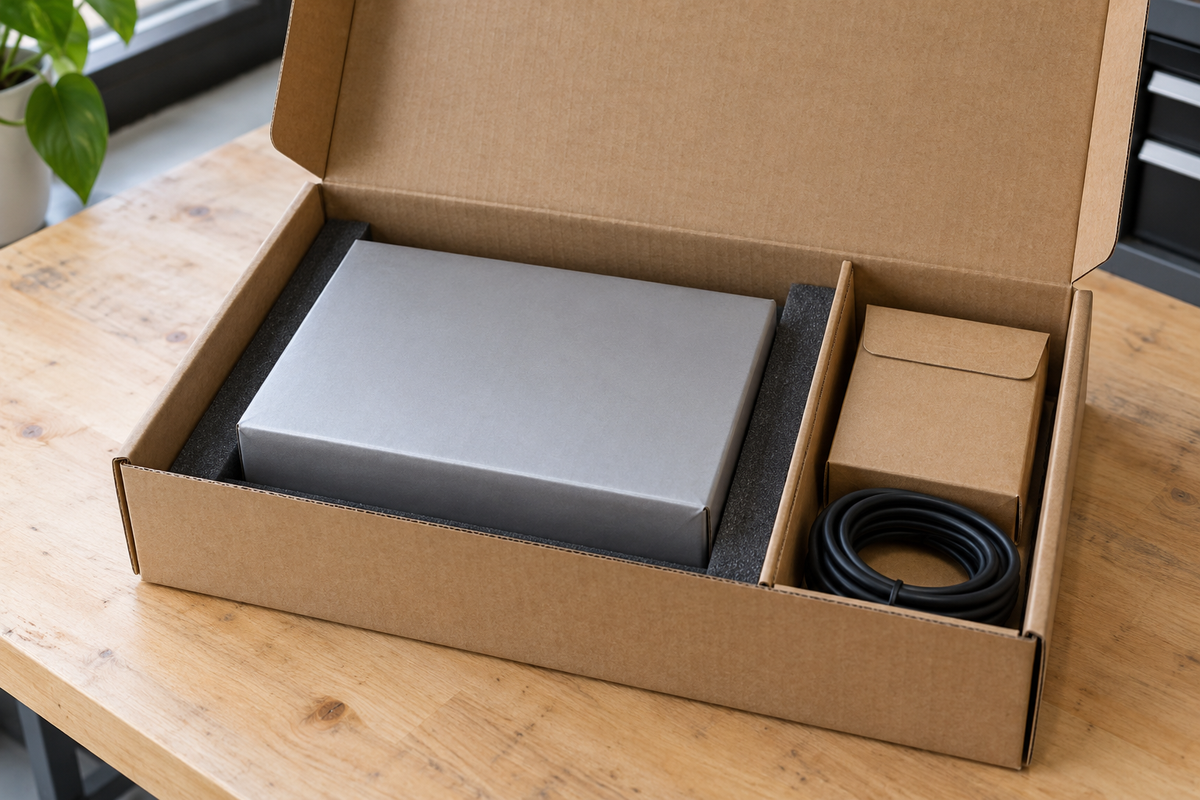
A CNC controller kit may arrive as several separately protected electronic items plus cables, manuals and other accessories. Before combining them, identify which protective packages will remain closed and whether any proposed work crosses that boundary. “Put everything in one box” is incomplete when it leaves opening or replacement of electronics packaging to the packer’s discretion.
The buying decision is whether the proposed consolidation preserves the applicable protective arrangement or requires an authorized ESD process. It is separate from controller compatibility, firmware, software licensing and commissioning. An orderly kit list does not itself establish that its electronics have been protected appropriately.
Identify the electronics and the supplied protective arrangement
Start with the exact controller, board or module identity and the manufacturer’s packaging instructions for the supplied product. Distinguish a complete enclosed controller from separately supplied electronics in the order records. Avoid transferring the packing requirements of one item to everything bearing the same controller-family name.
Ask the supplier to identify the existing protective package and explain which manufacturer instruction governs it. Record the accessible package references and the supplier’s description of the closed state. If the information is missing, retain that uncertainty instead of classifying the packaging by color or appearance.
The EOS/ESD Association distinguishes low-charging properties, conductive or dissipative behavior and discharge shielding. Its packaging guidance adds discharge shielding for use outside an ESD-protected area. These are distinct functions, so a broad description such as “anti-static” leaves important evidence questions unanswered. The actual product and handling context still need a qualified packaging decision. EOS/ESD Association packaging guidance
Ask for the information appropriate to the actual item rather than setting universal numerical limits. This article does not specify bag construction, grounding arrangements or an electronics-handling method. The responsible electronics provider should determine the applicable requirements and the evidence needed to support the proposed arrangement.
Mark the boundary between outer consolidation and opening
Have the packer describe whether it will combine intact supplied packages or open them. A change to the outer shipping container can be reviewed without assuming that opening the electronics protection is part of the job. Make the intended boundary explicit in the proposal.
List each proposed action that would alter a protective package: replacement, removal, opening for a photograph or access to a concealed identifier. Ask why the action is needed and which authorized provider will own it. A request for better paperwork should not silently become permission to expose a controller board.
If the required information can be supplied through existing records or accessible external labels, ask for that route first. Where the evidence remains insufficient, let the responsible electronics provider define an authorized alternative. Do not instruct a general packer to reproduce an ESD workspace from a checklist in a purchasing article.
The closed-package boundary is also relevant to accessories. Ask which accessories can be accounted for from their own packages and which are already inside the electronics protection. Avoid assuming every small item is missing simply because it is not visible in the final outer-box photograph.
Request evidence for replacement packaging
A replacement proposal should identify the exact packaging product or system and explain why it is appropriate for the actual electronics and shipment scope. Ask the responsible provider for applicable manufacturer information and any required supporting evidence. A generic catalogue image or an unexplained ESD symbol does not connect the proposal to the order.
Keep the packaging specification and evidence of the work performed separate. A data sheet describes a product; the supplier still needs to identify what it actually used and who performed the authorized work. Likewise, a photograph of a completed bag does not document every relevant process condition.
Ask whether the proposal changes any other protection requirements identified by the electronics manufacturer. If the maker specifies additional conditions, retain them in the scope rather than treating ESD terminology as a complete answer. Do not invent moisture, storage or temperature limits that the product documents have not established.
If the required evidence is unavailable, keep the replacement proposal unresolved. Ask for a plan preserving the existing authorized protective arrangement or an appropriate provider’s review. Missing paperwork should not be converted into a technical pass merely to complete the kit.
Build a consolidation-boundary worksheet
The following original editorial method organizes responsibilities and evidence. It is a buyer’s review tool, not an ESD control program or a certification scheme.
- Electronics identity: exact supplied item and order line, with unclear variants identified separately
- Maker sensitivity and packaging instruction: applicable reference and any unanswered product-specific question
- Existing closed barrier: the actual supplied protective-package description and accessible identification evidence
- Consolidation boundary: the approved outer-package work and any opening or replacement proposed as a separate change
- Authorized opening provider: the party responsible for any permitted access, including its agreed scope and instruction reference
- Replacement packaging evidence: identified proposal, supporting documents and the responsible provider’s disposition, where replacement is requested
Review the worksheet against the final supplier response. If the packer promises to leave the bag closed but the evidence request requires a photograph of a hidden board marking, the instructions conflict. Resolve that contradiction before work begins rather than expecting packing staff to choose which instruction matters more.
Retain the answer for each electronic item. A controller kit may include differently packaged modules, and one provider response may cover only part of the shipment. Do not extend it to unnamed items merely because they share an outer carton.
A fictional controller-board consolidation
Consider a fictional order containing a controller board in a sealed protective bag and separately packed cables. The proposed kit layout removes the board from that bag and puts it in ordinary cushioning beside the accessories. No product-specific packaging review or authorized opening provider is identified.
The buyer records the proposed change and keeps it unapproved. The immediate question is who can authorize and perform the replacement packaging for this actual board. The original bag’s appearance alone does not prove its protection, while the proposed cushioning has no supplied evidence establishing an appropriate replacement.
Ask for the maker’s applicable packaging information and a plan that preserves the authorized protective arrangement. If the supplier can consolidate the existing closed package with the accessories under an appropriate outer packing proposal, that may avoid the proposed opening. It still requires the responsible provider’s review of the actual arrangement.
If opening is genuinely required, ask the electronics provider to define its authorized scope and replacement packaging evidence. The buyer then reviews the provider, commercial implications and documentary output. No grounding, wrist-strap or exposed-board handling instructions are supplied by this example.
Suppose the board label cannot be photographed through the existing package. Keep that limitation in the record and seek supplier identification evidence or an authorized assessment route. Do not call the electronics unidentified simply because one preferred photograph is unavailable, and do not invent an identifier to fill the gap.
Close the packaging question separately from function
The final record should identify the electronics, accepted protective arrangement, permitted consolidation work and any authorized opening or replacement that occurred. Preserve unresolved differences with a named responsible contact. A complete record makes the scope reviewable; it is not proof of controller functionality or ESD immunity.
Our role is an independent buying agent coordinating supplier questions and purchase information. ESD-sensitive handling and technical packaging decisions need an appropriately authorized provider; no in-house ESD facility or certification is implied. See CNC controller sourcing for the broader purchase context.
Use the CNC quote request with a supported listing link, text description or up to five PNG, JPEG, WebP or GIF images, at most 10 MiB each and 20 MiB total. The image field does not accept PDF, CAD or ZIP files. Arrange manufacturer instructions and technical reports through a separately authorized exchange.
Frequently asked questions
Does an anti-static description prove a controller package is suitable?
It leaves the actual protective functions and product applicability unresolved. Ask for the packaging identity, applicable maker instructions and the responsible electronics provider’s decision for the proposed shipment.
Can controller electronics and accessories share an outer carton?
Ask for a proposal identifying which supplied protective packages remain intact and how the outer arrangement is approved. A shared carton should not silently authorize opening or replacing electronics protection.
What if an identification photograph requires opening a protective bag?
Resolve the conflict before packing. Request existing supplier records or accessible external evidence, or have the responsible electronics provider define an authorized identification route.
Does an accepted ESD packaging plan prove the controller works?
No. Packaging-scope acceptance and functional acceptance answer different questions. Any controller testing or commissioning requires its own agreed scope and qualified provider.
Sources
Discuss a sourcing request related to this article.Specify the ESD Packaging Boundary for a CNC Controller Kit