
CNC Tool Reconditioning Freight: Budget for Tools That May Be Rejected
Define regional collection, return carriage and rejected-tool terms before treating a reconditioning shipment as economical replacement stock.
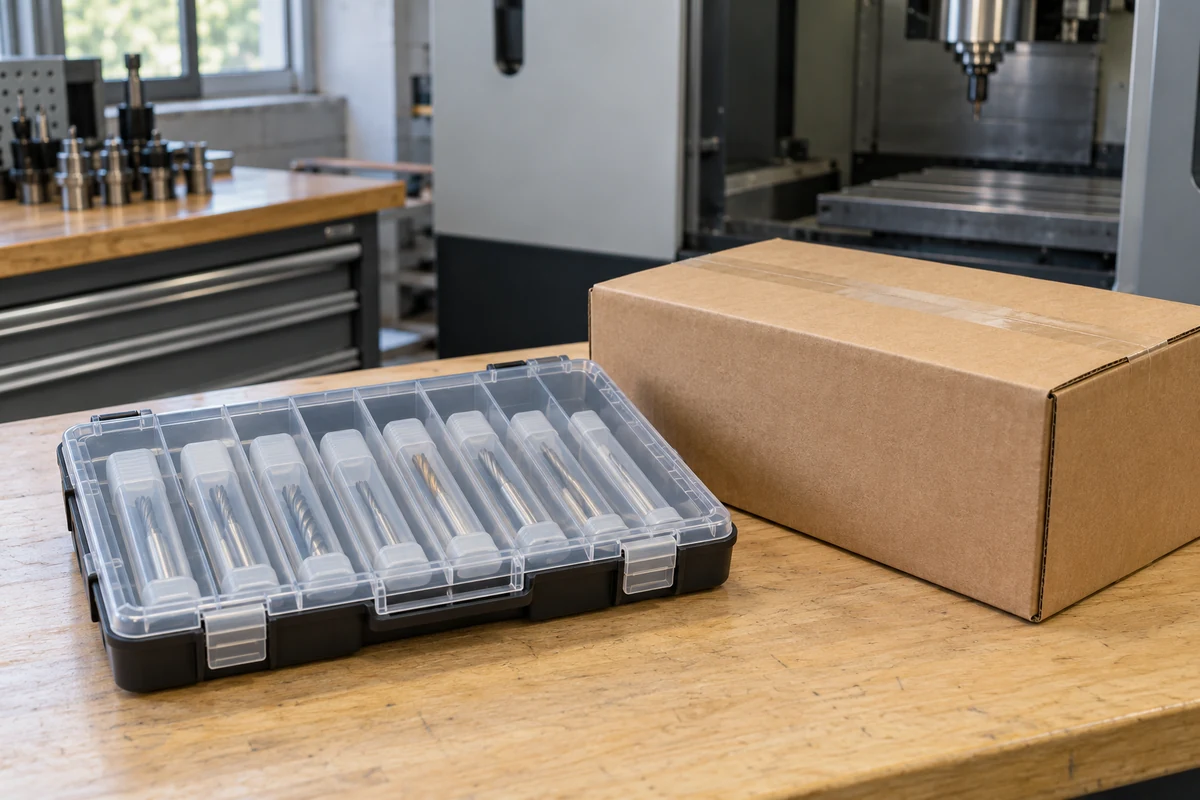
A CNC tool-reconditioning freight budget should cover the proposed service journey, including what happens to cutters the provider cannot recondition. The count sent for assessment is not a confirmed count of useful service results, and “prepaid shipping” should be read within the exact programme offered.
Before dispatch, identify the eligible tools, regional service route, outbound payer, return arrangement and rejected-item terms. This is a freight-commitment decision. It does not predict reconditioning yield, select a grinding process or establish that returned tools can replace new stock.
Identify the service route for the actual tools
Prepare a list of maker, complete tool reference, quantity and available service history. Distinguish known identities from uncertain items. Ask the proposed regional contact which tool families and service types it can consider before combining them into one consignment.
Kennametal’s US reconditioning page directs customers to their local service contact and identifies its offering for specified Kennametal tool families. It also describes regional order arrangements. These published programme details are a starting point for an enquiry, not acceptance of a mixed box from any origin. Kennametal reconditioning services
Ask who will receive the tools and whether another facility or route is needed for any part of the list. A shared brand or similar tool appearance should not be used to assume that one service centre handles every requested process.
If identity is missing, ask the service provider what evidence it needs. Do not invent a product code or assume that a tool belongs to a supported family because its diameter resembles a listed item. Keep unresolved candidates visible in the proposed batch.
Find the boundary of prepaid collection
Kennametal describes its Blue Box programme as including prepaid shipping. Its page also says tools that cannot be reconditioned are returned with the completed order and an explanation. Neither statement establishes worldwide free two-way shipping for the reader’s batch. Confirm the current regional offer and its actual charges with the responsible contact. Kennametal programme and return information
Ask exactly what a prepaid arrangement covers: the eligible sender location, named receiver, authorized service, applicable batch scope and whether return carriage is included. Where the answer is limited, retain that limit beside the shipping line.
A pickup quote is also distinct from physical-tool acceptance. Sandvik Coromant’s November 2025 process video describes quotation and collection followed by inspection at the reconditioning centre. The sequence illustrates why collection can precede the tool-specific service decision; it is not a guarantee for an unexamined cutter. Sandvik Coromant: reconditioning process
No public programme price or turnaround should replace the actual offer. Ask for any assessment charge only if it applies to the proposed service, and keep it separate from freight rather than importing a fee from an old form.
Obtain the rejected-tool terms before the outward journey
Ask what happens to each item that cannot enter the agreed service scope. The answer should identify whether the provider returns it with completed tools, returns it separately or seeks another owner decision. Confirm the commercial terms for the applicable outcome.
Also ask about the case where no tools are accepted for reconditioning. A statement about returns accompanying a completed order may leave that situation unanswered. The buyer needs the provider’s response before assuming that an unsuccessful batch has no return obligation.
If the provider offers another disposition, preserve the actual proposal and obtain the owner’s authorization through the appropriate process. Silence should not become permission to discard tools. This article supplies no disposal or physical handling directions.
For a partial service result, ask whether completed tools and rejected items travel together or in different dispatches. That distinction can affect the quoted freight scope and receiving records, but no additional charge is presumed until the provider states it.
Compare the full journey with an unknown result count
Use the actual committed outbound and return charges, plus any quoted assessment or service costs relevant to the decision. Preserve included, excluded and conditional items. Avoid counting return carriage twice if it is explicitly part of the service offer.
For planning, consider two qualitative scenarios: the provider accepts the intended batch, or it accepts fewer tools and the remainder follows the stated return terms. These are possibilities to test against the offer, not predicted acceptance rates.
If the buyer later calculates a cost per usable service result, use only the identified tools actually returned and accepted for the intended requirement. At the dispatch decision, that denominator remains unknown. A cost divided by the number sent can describe spending per submitted tool, but it cannot be presented as spending per usable replacement.
A quote that is worthwhile only if every candidate succeeds deserves that dependency in plain language. The buyer can then decide whether the uncertain result is acceptable without a fabricated percentage making the analysis appear precise.
A batch-freight worksheet
| Entry | Question to settle |
|---|---|
| Candidate tools | Which identities and quantities are proposed? |
| Regional route | Which facility and current programme apply? |
| Eligible scope | Which tools can be considered, and what awaits inspection? |
| Outbound movement | Who pays and what does prepaid or quoted collection cover? |
| Return movement | What is included for completed and rejected items? |
| No accepted tools | Which charges and owner decisions apply in that case? |
| Other quoted costs | Are assessment or service amounts separately identified? |
| Result count | What remains unknown before physical assessment? |
| Inventory handoff | Who reviews the returned specification for the intended demand? |
This is an original commercial worksheet, not a provider’s order form or packing instruction.
A fictional mixed cutter batch
A fictional workshop has a mixed group of worn cutters and sees a prepaid collection programme. Some tool identities are established; others have not yet been matched to a supported service family. The buyer is considering sending everything and treating the shipment count as its replacement-stock plan.
First, the buyer sends the known list to the regional contact and identifies the uncertain items. It asks which candidates the facility can consider and what the freight offer covers. It also requests the return terms for rejected tools and the outcome if nothing is accepted.
Suppose the provider confirms collection for a defined batch but leaves acceptance subject to inspection. The buyer can approve the commercial exposure only on that basis. It keeps fewer accepted tools as a scenario and obtains the relevant return terms without inserting a predicted yield or a price for rejection.
When the service results are available, the return record should distinguish completed and rejected tools. The tooling owner separately reviews the returned specification. Freight completion does not establish how many new-tool purchases can be cancelled.
Commit to a defined service journey
Before dispatch approval, reconcile the actual tool list, regional offer and both freight legs. A later addition of another tool family should go back to the service contact rather than silently inheriting the first batch’s terms.
We act as an independent buying agent and can organize supplier proposals within an agreed scope; we do not recondition tools or guarantee their acceptance. See CNC cutters and end mills, then start the CNC quote request with a supported listing link, description or images. Up to five PNG, JPEG, WebP or GIF images are supported, at most 10 MiB each and 20 MiB total. Arrange service forms and technical reports through a separately authorized exchange.
Frequently asked questions
Does prepaid tool-reconditioning shipping include the return?
Ask the regional provider to identify the exact legs, sender location, receiver and service scope covered. A public prepaid collection statement is not a worldwide two-way entitlement. Preserve the actual offer’s inclusions and exclusions before adding a return line or assuming it is already included.
Who pays when a cutter cannot be reconditioned?
Use the actual provider’s rejected-item terms. Ask about return with completed tools, a separate return and the case where no tools are accepted. Keep any assessment or return charge tied to the current offer rather than importing a fee from an old form.
Should a mixed cutter batch go to one service centre?
First identify the tools and ask the regional contact which families and services its facility can consider. Different items may need a different proposal. A common box or brand does not establish that every cutter is eligible for the same collection programme or physical assessment.
Can I calculate freight per replacement from the number of tools sent?
That calculation gives cost per submitted candidate, not per usable replacement. Service acceptance and the buyer’s review of returned specifications are still open. At dispatch, use explicit qualitative scenarios and the actual financial obligations without inventing an acceptance rate or assuming all tools will cover new-tool demand.
Sources
Discuss a sourcing request related to this article.CNC Tool Reconditioning Freight: Budget for Tools That May Be Rejected