
Check What a CNC Toolholder Balance Report Covers
Check assembly coverage, balancing basis and residual-unbalance results before treating a holder certificate as acceptance of the supplied tool system.
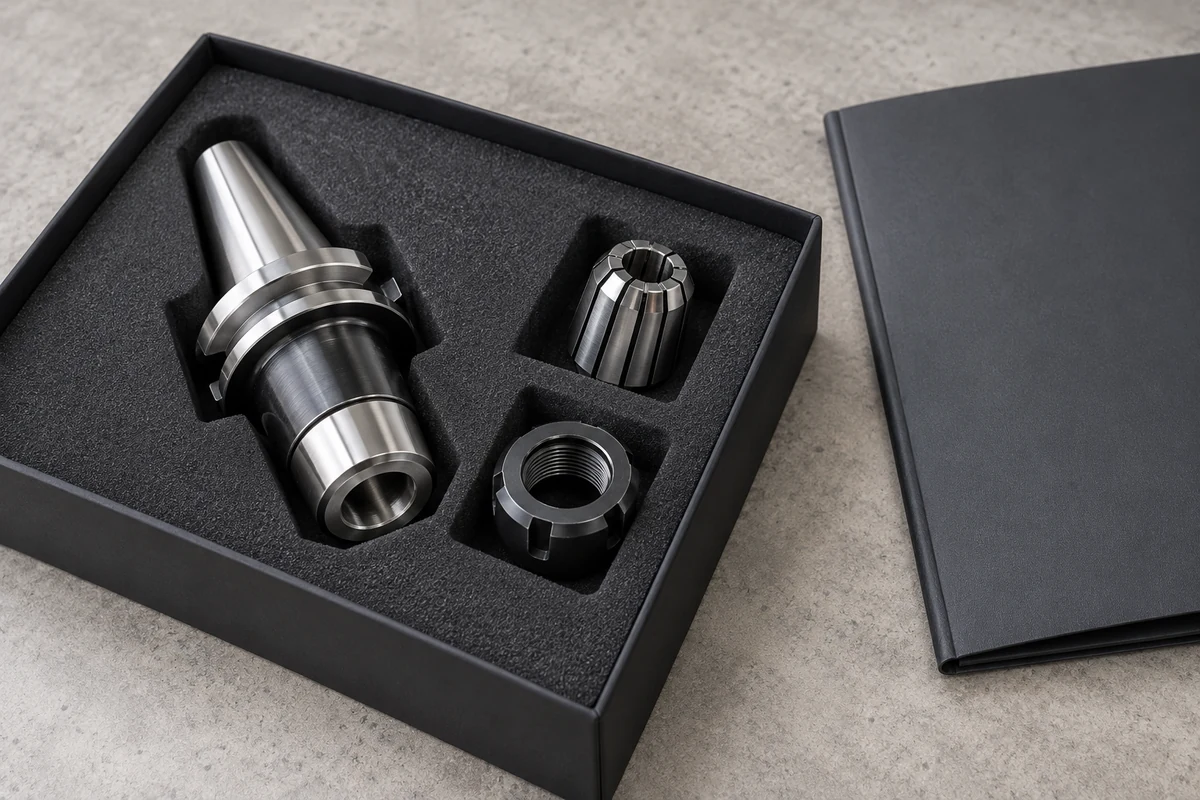
A toolholder balance report should identify the actual assembly assessed and the balancing requirement it was assessed against. A certificate naming an empty holder cannot silently become evidence for that holder with a collet, nut and cutter. Start by locating the reported residual-unbalance result, its unit, the assembly definition and the basis used for the conclusion.
This is an editorial document-review method, developed from the linked primary sources checked on 13 October 2026. No delivered assembly, actual purchase report or physical test was supplied. The aim is to recognize an evidence mismatch, not calculate a permissible unbalance or authorize a spindle speed.
Balance evidence answers a different question from runout
The public abstract of ISO 16084:2017 addresses static and dynamic residual unbalance of rotating tools and tool systems, including assembled modular systems. Its subject is balance. A geometrical runout reading therefore cannot be substituted for the balance result simply because both documents concern the same holder. ISO 16084:2017 public scope
Keep the two requirements separate in the receiving record. If the supplier sends a dimensional or runout report in response to a balance request, preserve it under its actual characteristic and ask for the missing balance evidence. Do not change its heading or infer mass-distribution performance from a small geometric deviation.
Likewise, the word “balanced” in a catalogue is not the actual delivered-unit result. Record whether the evidence is a product specification, a declaration about a supplied item, or a measurement report for an identified assembly. Ask the qualified reviewer which kind of evidence the approved order requires.
Identify the complete assessed assembly
Read the report’s item description and component list before comparing the outcome. Which holder is named? Were a nut, collet, cutter or other accessories included? Was the cutter supplied with the order or was a separate test item used? Only include components that the provider actually identifies; a photograph cannot resolve every concealed component.
The ISO public scope specifically recognizes assembly and clamping dislocations within modular tool systems and at the spindle interface as relevant to balancing. That supports retaining the assessed configuration and any later change. It does not allow the buyer to predict how much an undocumented change alters the result. ISO assembly and clamping scope
Request the assembly configuration reference used by the provider, including the component identities and documented arrangement relevant to its method. The receiving reviewer should compare that record with what was delivered, not attempt to recreate the assembly to see whether it looks similar.
If a supplied nut or cutter differs from the report, list the exact difference and refer it to the technical owner. Do not assume that a lighter component improves balance or that a visually identical replacement preserves it. The needed conclusion is whether the evidence still applies, with an attributable explanation.
Preserve the balancing basis behind a grade label
A label without its reference leaves the buyer unable to judge what was evaluated. Ask for the applicable method or standard reference and edition, the buyer-approved requirement and the speed basis used where relevant. Preserve the source language rather than translating an unfamiliar designation into a familiar grade.
BIG DAISHOWA’s Tooling Today discussion describes physical holder information and speed/balance requirements as inputs behind residual-unbalance results. This supports requesting the stated basis with the result. The article’s broader performance and standards-comparison claims are not needed for this receiving decision. BIG DAISHOWA Tooling Today 2023, page 11
Keep a speed entered for a balancing requirement distinct from a measured test condition or the assembly’s permitted operating speed. Ask the provider to label each explicitly if several speed fields appear. A number printed next to a grade should not be promoted into operating permission without the appropriate equipment documentation and technical approval.
If the original purchase says only “balanced toolholder,” identify that ambiguity. The buyer and responsible tooling specialist need to define how the present evidence will be judged. They should not pretend that an unstated universal grade or speed was contractually agreed from the outset.
Read the residual result with its unit and plane scope
A report may distinguish a permitted value, an initial condition and the residual result after the reported balancing work. Preserve those labels. Ask which entry is the result being offered for acceptance and whether the conclusion actually compares it with the agreed requirement.
BIG DAISHOWA’s discussion presents residual unbalance in gram-millimeter terms. That is a mass-distance quantity, not a length-only runout value. Retain the exact reported unit; do not strip it off, compare unlike quantities or treat matching numerical digits as equivalent performance. BIG DAISHOWA residual-unbalance discussion
Where the provider reports separate planes, retain each plane identifier, result and associated acceptance reference. Where it reports only a summary, ask what that summary covers. Do not add plane values, choose the most favorable row or prescribe one-plane or two-plane balancing from the shape of a photograph.
Also ask for the provider’s stated method limitations and measurement-confidence information appropriate to the decision. The public ISO abstract establishes the subject’s scope but supplies neither the full method nor a purchase-specific acceptance value. A standard title in the report is not proof that every applicable requirement was followed.
| Balance-specific field | Evidence to retain | Unresolved question |
|---|---|---|
| Assessed assembly | Holder and included component identities | Does the result cover what arrived? |
| Requirement basis | Approved reference, method and edition | What does the stated grade mean here? |
| Speed context | Clearly labelled basis and test-condition fields | Which role does each speed play? |
| Reported quantity | Residual result, original unit and plane labels | Is this the relevant result rather than a target? |
| Configuration change | Differences after the recorded assessment | Is the report still applicable? |
| Technical disposition | Reviewer and accepted scope | Which balance requirement is closed? |
Work through a fictional holder-only certificate
Imagine an invented order for assembly A-17: holder H-17, collet C-17, nut N-17 and cutter T-17. The order requires balance evidence for the identified supplied assembly. A certificate arrives naming only H-17 and a grade label, with no component list, result unit or balancing-reference information. All identifiers and events are fictional.
The first conclusion is documentary: H-17 is named, while assembly coverage and the result basis are unresolved. The certificate does not establish that A-17 failed. It also does not complete the requested assembly evidence. The buyer should avoid both conclusions until the provider explains what it assessed.
The clarification request names four specific gaps: identify the assessed components, state the balancing reference and relevant speed basis, provide the residual result with its unit and reported plane scope, and explain whether any component changed afterward. There is no instruction to spin the assembly or make a balancing correction.
Suppose the provider confirms that only the bare holder was assessed. That establishes the certificate’s boundary. The responsible reviewer decides what further evidence is needed for A-17 under the agreed requirement. If the supplier instead produces an attributable assembly record, compare its component identities and basis before considering the scope gap closed.
Now suppose that record names a different nut, N-22. Retain the discrepancy even if the supplier calls the nuts equivalent. A qualified explanation or additional agreed evidence is needed to resolve applicability; the buyer should not substitute a claim of geometric fit for a balance conclusion.
Close the balance requirement without a broader performance claim
Record the accepted assembly, report revision, result basis and qualified decision. Preserve any outstanding limitations. Accepted balance evidence does not independently establish runout, retention, bearing condition, cutting performance or safe machine operation, and an unexplained vibration should not be diagnosed from this paperwork alone.
We act as an independent buying agent and can organize supplier evidence and clarification requests. Technical assessment requires an agreed competent provider. See CNC spindle sourcing, then use the CNC quote request to identify the holder and missing documentation.
The form accepts supported product links, descriptions and up to five PNG, JPEG, WebP or GIF images, at most 10 MiB each and 20 MiB total. Arrange report PDFs and other technical-file exchange separately through an authorized channel.
Frequently asked questions
Can a runout report prove that a toolholder assembly is balanced?
No. Geometrical runout and residual unbalance are different reported characteristics. Request balance evidence for the identified assembly and agreed requirement.
Does a bare-holder certificate cover the holder with a cutter fitted?
Do not assume that coverage. Ask the provider which components and configuration were assessed and have any difference reviewed against the agreed assembly requirement.
Does a balance grade printed beside a speed authorize that operating speed?
No. Ask what the speed field represents. Balancing basis, test conditions and permitted operating speed need their own applicable documentation and technical decisions.
Should I combine separately reported plane values into one acceptance number?
Keep the provider’s original plane labels and result definitions. The responsible reviewer must interpret them using the applicable method; do not invent a combined value.
Sources
Discuss a sourcing request related to this article.Check What a CNC Toolholder Balance Report Covers