
CNC Machine Packing: Freeze the As-Shipped Assembly State
Agree what stays installed, what arrives separately and who owns the resulting destination work before a CNC packing proposal changes assembly scope.
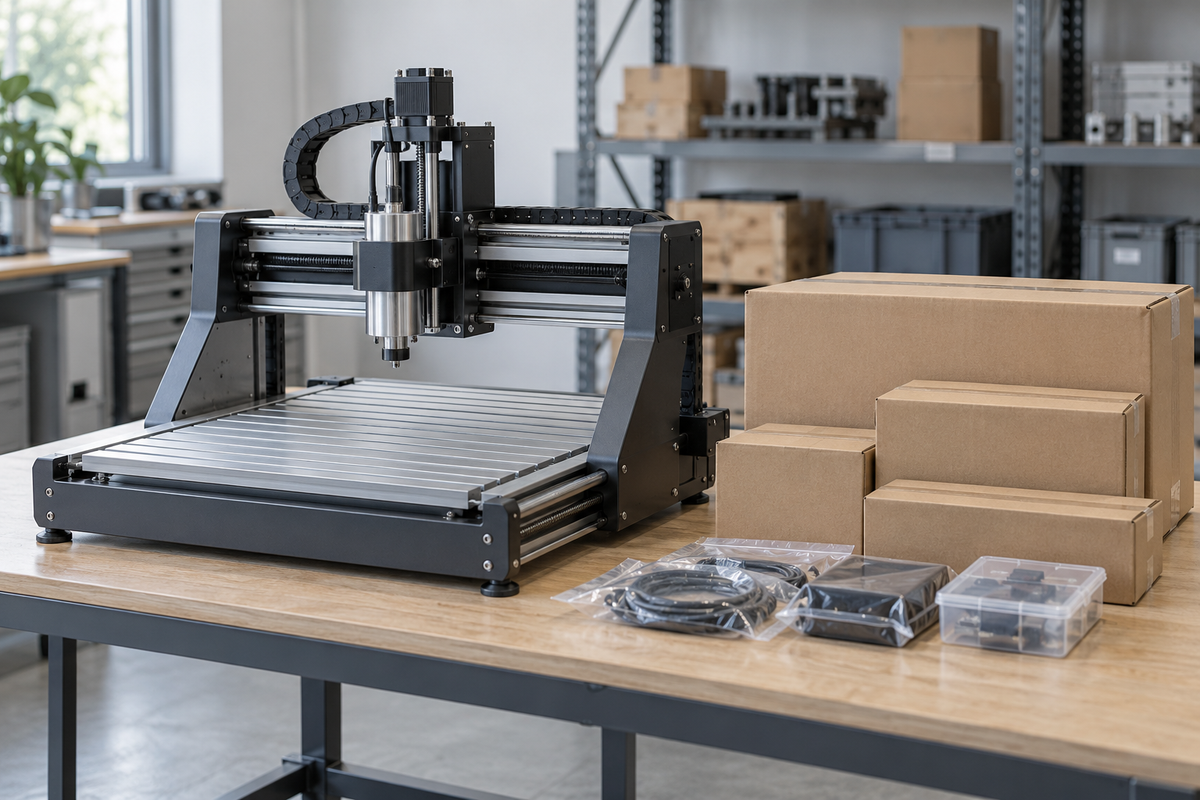
Before approving a CNC machine’s packing plan, agree which assemblies will remain installed and which will arrive separately. If the packer proposes a different assembly state from the one the buyer accepted, identify the resulting destination work and obtain the relevant approvals before treating the change as settled.
A complete contents list can still leave this question unanswered. A machine and its detached gantry may contain the same purchased parts as an assembled machine, while presenting a different handover to the destination provider. This article concerns that packing-driven change. The comparison method is original editorial guidance for a buying decision; it gives no dismantling, lifting, fastening, wiring or alignment instructions.
Recover the assembly state the buyer actually accepted
Start with the approved machine reference, configuration and sale description. Find any wording about assembled delivery, partial assembly, a kit or installation services. Read those statements together with the accepted scope, rather than relying on the headline “complete machine.” If the documents do not define the delivered assembly state, record the ambiguity before the packing proposal becomes the working assumption.
Identify the evidence behind that description. A listing image may show a display machine assembled for demonstration. A pre-sale test may concern a configuration before transport preparation. Neither should silently define the promised as-shipped state. Ask the seller to connect its proposal to the exact purchased configuration and the applicable manufacturer instructions.
For a kit, establish the agreed starting state just as carefully. Partial assembly may already be part of the purchase. The question is whether the packing plan preserves that agreement or introduces additional work that the buyer has not accepted.
Describe the proposed change as a handover difference
Ask the seller to list what remains attached, what is proposed for separate supply and why the proposal differs from the accepted baseline. Use the machine’s documented assembly names. A phrase such as “accessories removed” can hide whether the proposal concerns a loose optional item or a machine assembly with destination work attached to it.
For every changed item, ask which maker instruction or authorized technical response supports that transport state. A smaller package is a commercial objective, not the authorization itself. The provider responsible for preparing the machine should identify the applicable arrangement without asking the buyer to invent a disassembly method.
Keep “may be separated” distinct from “will be supplied separately.” The first may be a technical option. The second describes the proposed delivery and needs a matching scope. Likewise, permission to separate an assembly does not by itself tell the buyer who will restore the required machine configuration at the destination.
Distinguish supplied equipment from operational readiness
Haas’s Compact Mill installation page assigns final installation and software activation to an HFO service technician. That model-specific example shows why a delivered machine can still have a defined installation stage. It does not prescribe the service arrangement for another manufacturer’s machine or authorize any packing-driven removal. Haas Compact Mill installation, Activation section
For the actual purchase, ask the responsible provider to define the destination handover implied by the proposed assembly state. Which work is within the seller’s agreed scope? Which work needs a separately appointed provider? What documentation must that provider review before accepting the assignment?
Keep completion statements precise. A package count confirms neither restored assembly nor commissioning. An agreement to perform destination work is also different from evidence that the work has been completed. Record each approval at the stage it actually covers so the packing decision does not become an unsupported workshop-ready promise.
Get the destination provider’s response before accepting the change
Send the proposed as-shipped configuration to the person or organization responsible for the destination work. Ask it to identify whether the proposal falls within its intended scope, what inputs remain missing and which exclusions affect the buyer’s decision. The seller’s confidence that reassembly is straightforward cannot substitute for that provider’s acceptance.
Include the applicable machine documentation and the actual packing proposal through an authorized exchange. Where the records disagree, ask the originating parties to resolve the discrepancy. Do not reconcile a missing assembly instruction by combining a video for another model with a generic drawing.
Any change in service scope should be visible commercially. Ask for the proposed responsibility and any separately quoted work without assuming that the original machine price includes it. Avoid estimated labor hours, improvised cost allowances or an arrival-day promise. The buyer needs a supported scope before comparing the alternatives meaningfully.
A fictional gantry-removal proposal
Imagine a fictional buyer approves a compact CNC router as a complete assembled machine. The seller later proposes separating its gantry to fit a smaller package. The revised contents list still includes the gantry, controller and purchased accessories, but says nothing about who will perform the resulting destination work. This example describes no real machine or approved removal.
The correct first question is what changed between the accepted assembly state and the proposed delivery. Retain the seller’s stated packaging reason, then request the exact machine manufacturer’s authorization for the proposed state and an account of the destination responsibility. Do not infer that receiving all the components preserves the original handover.
Suppose the seller replies, “All parts included; easy to assemble.” That reply addresses membership and offers an opinion about effort. It leaves the requested technical basis and destination owner unresolved. The buyer should keep this change unapproved while asking for a proposal the relevant providers can actually review.
There are several possible outcomes. The seller might retain the accepted assembly state. It might offer a manufacturer-supported separated state with an agreed destination provider and revised commercial scope. Or the buyer might decline the proposed change. None follows automatically from the smaller package. The record should capture the selected outcome without turning the article into instructions for moving or rebuilding the gantry.
Freeze a state comparison, not just a component list
An as-shipped assembly comparison can be short if it answers the actual change. The following fields form an editorial review aid:
- Approved machine and sold configuration, with the relevant agreement reference
- Accepted assembly state and any ambiguity in that baseline
- Proposed separately supplied assemblies and their applicable maker authority
- Preparation provider responsible for the approved transport state
- Destination provider’s accepted scope, exclusions and missing inputs
- Buyer decision on the revised delivery, linked to the exact proposal version
- Separate commissioning responsibility and the evidence needed at that later stage
Use a changed-assembly row only where there is a real difference. There is little value in reproducing every screw from the contents list when the unresolved issue is a detached major assembly. Conversely, do not hide several distinct destination responsibilities behind one broad “customer assembly” entry.
Preserve the boundary through packing handover
Before the packing issue is released, have the responsible parties reconcile the accepted comparison with the proposal they intend to execute. If another component is to be separated, return the affected scope for review. Approval of one identified change should not be treated as blanket permission to dismantle whatever makes the package smaller.
An independent buying agent can coordinate documents and supplier answers for the buyer. The machine maker and authorized technical providers determine supported preparation and destination work. The CNC router kits category gives broader purchase-scope context.
Use the CNC quote form for a supported listing link, description or images showing the purchase and proposed change. It accepts up to five PNG, JPEG, WebP or GIF images, no more than 10 MiB each and 20 MiB total. Arrange manuals, assembly records and other technical files through a separately authorized exchange; PDF, CAD and ZIP files are outside the image field.
Frequently asked questions
Does a complete machine quote define the as-shipped assembly state?
Only if its agreed scope makes that state clear. Ask which assemblies remain installed and which arrive separately, then connect that description to the accepted configuration and applicable maker instructions.
Can a smaller crate justify removing a machine assembly?
It explains a proposed commercial benefit. It does not establish technical permission or destination responsibility. Obtain those answers for the exact configuration before approving the change.
Is destination reassembly automatically included in the machine price?
Use the actual agreement. Ask the seller and destination provider to identify included work, exclusions and any separately quoted scope rather than assuming the original price covers a changed handover.
Does accepting the shipped assembly state approve operation?
No. That decision defines the agreed delivery configuration. The responsible provider must separately complete the applicable installation and commissioning work before operational readiness can be established.
Sources
Discuss a sourcing request related to this article.CNC Machine Packing: Freeze the As-Shipped Assembly State