
Read the Installed CNC Extraction Commissioning Record
Read CNC extraction handover records against the installed hood, ductwork, process and results, keeping catalogue ratings and pressure readings in context.
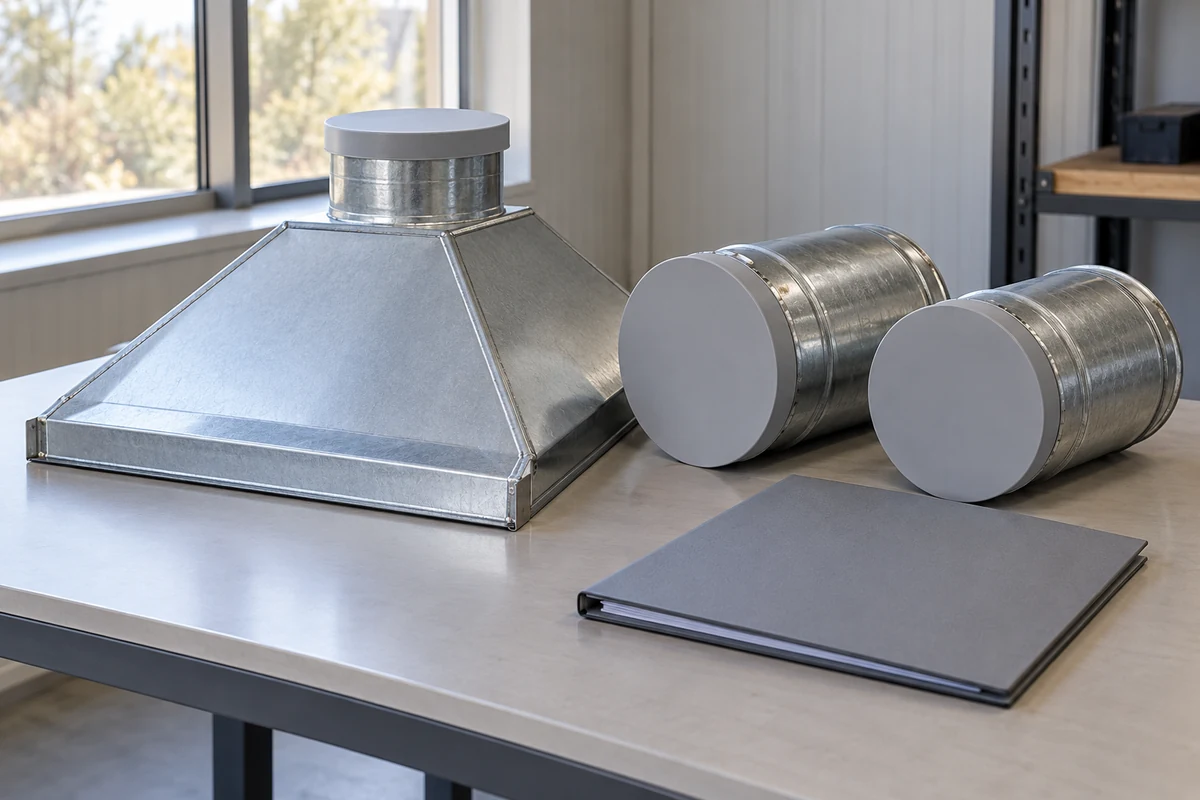
An extraction fan’s datasheet belongs in the equipment file, but receiving acceptance needs evidence about the installed collection system and the process it is intended to control. Check whether the commissioning record identifies the actual machine connection, hood, duct arrangement, collector and relevant operating conditions before treating the installation as ready.
This article reviews the evidence handed over after installation. It does not size an extractor, calculate airflow, select a filter, classify a dust hazard or teach a physical test. Those tasks require the actual application and competent specialists. No installed system or real commissioning report has been supplied for assessment here.
Separate catalogue performance from the installed result
Retain the exact offered model and its applicable manufacturer documentation, including the conditions attached to its ratings. Donaldson’s Downflo Oval brochure, for example, labels its specified system-performance curves as fan performance with clean filters and describes the available external static pressure. Those conditions are part of the information, not optional footnotes to remove from a purchasing summary. Donaldson Downflo Oval brochure, page 10
A catalogue curve can inform a qualified design review. It is not a field result from the buyer’s hood and ductwork. Ask the commissioner to identify the installed arrangement and explain which measured or otherwise assessed results support the defined control objective. Do not copy a brochure airflow figure into a blank commissioning-results field.
Keep the process identity alongside the system identity. A report for one material and activity should retain that stated scope. If the buyer intends additional materials, fluids or operating combinations, ask the responsible specialist whether those uses are covered. An unchanged collector model does not by itself answer a changed application question.
Identify the installation that was commissioned
Use the system identifier and as-installed document revision cited by the provider. Connect its hood or pickup references to the machine and its drawing or schematic. Retain the collector, fan and filter identities, plus any stated discharge and make-up-air arrangements, so the report can be compared with the installation record.
HSE’s UK LEV commissioning guidance calls for identification of the system, process, substances, operating conditions, assessment methods and results. It also expects information about system configuration and a clear effectiveness summary. This provides a useful report-reading reference; it is not a universal legal determination or evidence that the buyer’s installation has passed. HSE: commission your LEV system
Ask the report author to mark any departure from the design it was given. A hose rerouted during installation or an added branch should appear in the final configuration record, with the responsible specialist’s assessment of its consequence. Keep an unresolved difference visible rather than treating the original design drawing as a photograph of the finished work.
Record whether the commissioned arrangement covers each intended operating combination. For a system serving more than one source, a result with one source in scope should not silently be extended to an unspecified combination. The commissioner must define what its evidence covers; procurement should preserve that definition without inventing a test schedule.
Do not confuse two pressure records
The meaning of a displayed pressure depends on the identified measurement and its location. Donaldson’s Airflow Controller manual describes system static pressure monitored at a selected point for airflow control. In the same manual, the Delta P Plus controller is described as monitoring differential pressure between clean-air and dirty-air plenums to indicate filter condition. These are different descriptions in that manufacturer’s documented arrangement. Donaldson Airflow Controller manual, printed page 3
Therefore, a supplier’s photograph captioned “pressure OK” needs clarification before it can answer a commissioning question. Ask which parameter is shown, its units, the recorded point or component reference, and how the commissioner interprets it against the approved requirements. A number without that context should remain an unidentified reading, not a conclusion about exposure control.
This distinction does not prescribe an instrument or demand those particular controllers. Use the documentation for the actual system. The review question is whether each result retains its intended meaning and is connected to the relevant acceptance basis.
Review the handover as a connected record
Use the following questions to find the missing connection between the delivered equipment and the provider’s conclusion. This is an editorial evidence-review method, not a commissioning procedure.
| Handover connection | What to locate |
|---|---|
| Design to installation | Accepted design reference, as-installed revision and disposition of changes |
| Machine to collection point | Identified CNC process and hood or pickup reference |
| Result to condition | Recorded operating state, parameter, units and result location |
| Result to conclusion | Commissioner’s interpretation against the specified control objective |
| Outstanding issue to owner | Restriction, corrective action owner and required review before closure |
| Accepted record to future use | Current instructions and the operating scope communicated to users |
HSE separately distinguishes the roles of designers, installers/commissioners and examiners. Its guidance calls for a full commissioning report, a user manual and logbook, and later examination against the commissioning report or equivalent. Those roles help the buyer find who owes a particular handover record. They do not mean a component seller has agreed to supply every professional service. HSE LEV roles and documentation
If the installation contractor and equipment seller are different organizations, record which one is responsible for each open answer. A delivery receipt can close the arrival of a fan while the installed-system acceptance remains incomplete. Keep that commercial milestone from becoming an operational permission.
Work through a fictional extra branch
Imagine a fictional router installation originally documented with one identified pickup. At handover, the buyer receives the fan brochure and a photograph of a collector pressure display. The as-installed sketch also shows an added branch to a second machine. No commissioning report identifies the final arrangement or the operating combinations it covers.
The buyer first records three separate items: the component documentation is present; the displayed parameter is not yet identified; and the changed system has no attributable commissioning conclusion. None establishes an airflow shortfall or a successful exposure-control result. The missing evidence remains the issue to resolve.
Ask the responsible commissioner for the final system reference, the process scope and the interpretation of the reported results. Suppose the returned report concerns the original one-pickup arrangement. Retain it under that scope and ask for a qualified decision about the added branch. Renaming the file “final report” cannot extend its coverage.
Donaldson’s Airflow Controller manual specifically notes that physical duct-system changes can require changed settings and recalibration for that controller. This is manufacturer-specific evidence that a system change can affect an earlier operating basis, not an instruction for the buyer to alter controls. The responsible provider must determine the appropriate work for the actual equipment. Donaldson system-change guidance, printed pages 3 and 11
All configurations and events in this example are fictional. Closure requires a competent conclusion for the accepted arrangement and its stated uses, with outstanding restrictions preserved. An unresolved second branch should not disappear behind a general “installed” status.
Keep the accepted operating scope available
Request a final handover that connects the current installation record, commissioning conclusions, restrictions and user documentation. Have the authorized owner decide whether it supports the intended next stage. Future changes to the machine connection, system or process should be referred for appropriate review rather than assumed to inherit the earlier conclusion.
Our independent buying-agent role is to coordinate equipment information and supplier questions, with specialist commissioning arranged separately where available and agreed. See CNC dust collection and start through the CNC quote form. It accepts listing links, descriptions and up to five PNG, JPEG, WebP or GIF images, limited to 10 MiB each and 20 MiB total. Reports, safety information and drawings needing PDF, CAD or ZIP exchange require a separately authorized route.
Frequently asked questions
Does a fan datasheet establish installed exposure control?
It documents the product under its stated conditions. Obtain the qualified commissioning evidence for the actual installation, process and operating scope before treating the system as accepted.
Is a pressure-display photograph enough commissioning evidence?
Identify the parameter, units, location and the commissioner’s interpretation. A system static-pressure record and a filter differential-pressure indication can answer different questions.
Can an original report cover a branch added after installation?
Do not extend its coverage automatically. Give the changed configuration to the responsible specialist and obtain a decision about the necessary review and updated evidence.
What must remain in the final handover after a defect is resolved?
Keep the current installation reference, qualified conclusion, operating scope, remaining restrictions and applicable user documentation together. Record who authorized closure of the particular issue.
Sources
Discuss a sourcing request related to this article.Read the Installed CNC Extraction Commissioning Record