
Separate Cutting Length, Neck Reach and Overall Cutter Length
Ask for the actual cutting section, neck dimensions and holder assumption before treating a cutter’s overall length as evidence of reach.
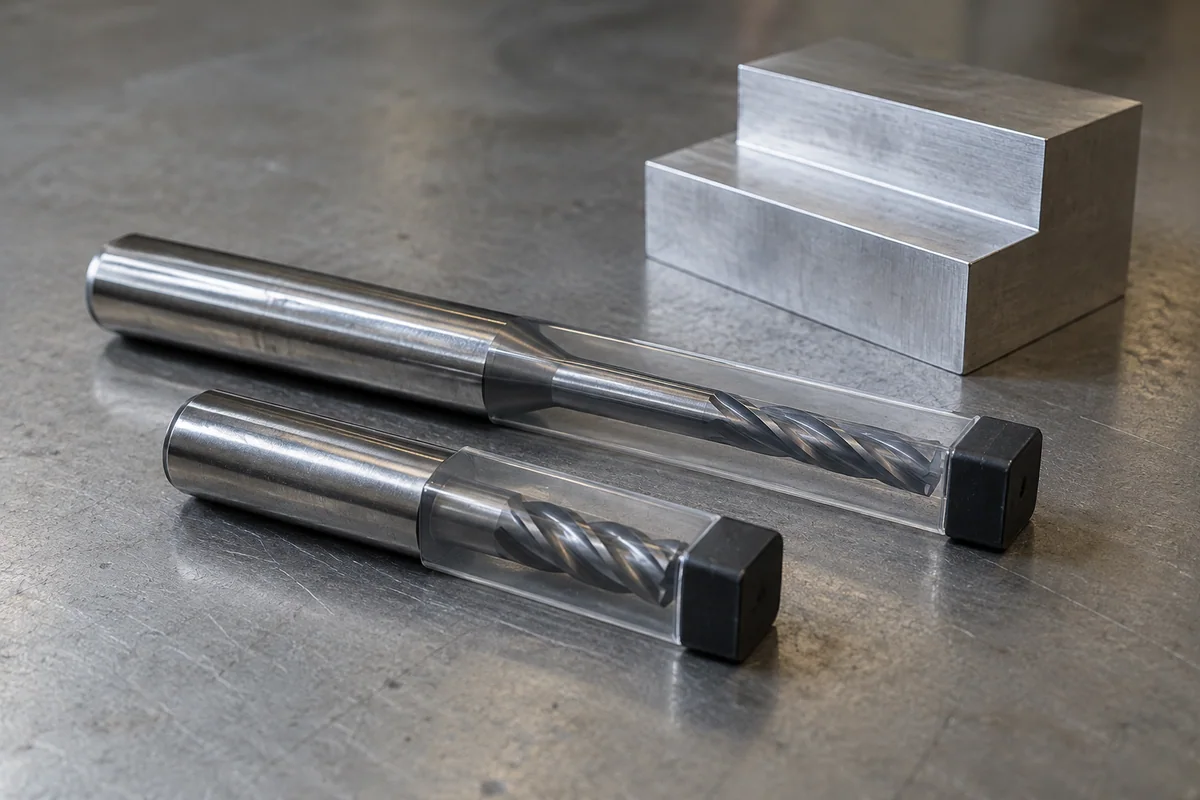
A cutter described as “60 mm long” has not yet answered a request for a tool to reach a particular feature. Ask the supplier to separate overall length, length of cut, neck geometry and the holder relationship on an exact-part drawing. The buying decision is which geometry should be submitted for application review, rather than which listing has the largest length number.
This is particularly useful when a marketplace title combines several dimensions without labels. An apparently detailed title can still leave the relevant length unknown. Start from the feature to be made, identify the missing geometry, and ask the toolmaker to propose a specific cutter with the assumptions stated.
Describe the feature before requesting a longer tool
Provide a drawing view or section that shows the feature’s depth reference and the surrounding shape. Identify the material and the intended operation in ordinary terms, such as finishing an internal wall or producing a recessed detail. If the operation has not been planned, say so and request application advice rather than turning a guessed strategy into a purchasing requirement.
A single depth number is rarely a complete description for a supplier proposal. Ask the responsible process planner which adjacent walls, shoulders or openings need to appear in the section. Identify the feature being discussed so the supplier does not solve a different access problem elsewhere on the part.
Include the exact holder where it is already selected. Where it is undecided, mark it as undecided and request the assumed holder in the response. Otherwise one supplier may base its proposal on a slim holder while another assumes an assembly the buyer does not own. That difference belongs in the comparison before either tool is selected.
Read each length from its own reference
Harvey Performance’s end-mill anatomy guide distinguishes overall length from length of cut. It also defines overall reach, or length below shank, for a reduced-neck tool. These are separate geometric descriptions; they do not by themselves establish an approved cutting strategy. Harvey Performance end-mill anatomy
Use the maker’s drawing labels in the RFQ. Do not assume every manufacturer’s “reach” symbol has an identical reference. Ask the supplier to point to the dimension rather than translating several terms into the generic word “length.”
| Geometry to identify | What the supplier should return | Question it helps the reviewer answer |
|---|---|---|
| Cutting diameter and end profile | Exact-part drawing and order code | Which feature geometry is being proposed? |
| Length of cut | Labeled cutting-section dimension | What cutting section does this tool provide? |
| Neck diameter and extent | Dimensioned reduced section, if present | Which part of the tool occupies the recessed region? |
| Overall reach or length below shank | Maker’s definition and reference points | Where does the larger shank section begin? |
| Overall length | End-to-end dimension | What is the total tool length? |
| Holder relationship | Identified holder and proposed assembly drawing | What assembly must receive the access review? |
The table requests evidence; it supplies no minimum clearance, approved projection or insertion depth. Those decisions must follow the selected tool and holder instructions and the actual application review.
Ask for a proposal that keeps the assumptions visible
Request a full cutter part number rather than “a long-neck equivalent.” Ask the supplier to connect its dimensional drawing to that orderable variant. If the listing contains several neck lengths, the drawing should identify the offered choice explicitly.
Harvey Tool’s product page for item 854208, for example, gives separate entries for length of cut, shank diameter and overall length. It illustrates how a specific product record can retain those distinctions. It is not a suggested cutter for the reader’s part, and this article makes no application claim for that item. Harvey Tool item 854208
Ask what the supplier still needs before the toolmaker can assess the proposal. A missing material designation, unresolved holder or unclear feature section should remain an open question. A quotation can be commercially complete while the tool selection remains technically unresolved.
Keep any suggested change to the part, holder or operation visible. If a seller’s response depends on approaching the feature differently, record that assumption for the process planner. The buying agent should not silently accept a new machining plan to make an available cutter appear suitable.
A fictional 60 mm cutter for a 20 mm feature
Suppose a buyer requests a cutter proposal for a feature described as 20 mm deep. The seller offers a 60 mm overall-length tool but provides no length of cut, neck dimensions or holder drawing. Both numbers are invented for this example; they are not recommended tool dimensions.
The buyer can record the reported overall length, but the feature has not been reviewed. Subtracting 20 from 60 produces 40 mm arithmetically. That remainder is not an approved exposed length, gripping length or clearance. It has no reliable meaning for the assembly without the missing references and instructions.
Now suppose the seller returns a drawing containing a labeled cutting section and a reduced neck, together with a specific holder assumption. The response becomes reviewable. It still does not establish whether the proposed cutter can perform the required operation, whether the holder clears the surroundings or whether the complete machine setup is suitable.
The next useful question is precise: ask the toolmaker to assess this cutter geometry for the identified feature, material and intended operation, and ask the responsible machine specialist to review the proposed tool assembly. If the review identifies another geometry, obtain its exact drawing and a revised quote. Preserve the original candidate as a rejected or superseded proposal rather than quietly altering its dimensions.
Compare two geometry proposals without choosing by length alone
When offers differ, compare the shape relevant to the feature. One may offer a longer cutting section; another may offer a shorter cutting section with a necked region. Record those actual differences and request the reasoning for each proposal. Do not assume the longer cutter is the more capable choice, or that a necked cutter is automatically suitable for every recess.
Ask whether the quoted tool is a standard catalogue variant or a custom item. A custom proposal needs its own approved drawing, scope and review responsibility. The RFQ should not authorize grinding, shortening or otherwise modifying an existing tool merely because the standard dimensions leave a gap.
Separate the cutter-geometry decision from the complete machine-envelope check. The latter includes machine travel, fixtures and the full movement plan and belongs in the broader setup assessment. This article’s outcome is a clearly identified tool proposal ready for that assessment, with unresolved geometry questions still visible.
Close the cutter inquiry with an exact deliverable
A useful supplier request is: identify the proposed cutter and drawing, label its cutting section and neck geometry, state the holder assumption, and list any application questions that prevent a recommendation. Ask for alternatives as separately identified tools so the buyer can see what changes.
If a sample evaluation is proposed, agree who will assess it, what the evaluation covers and which acceptance requirements apply. No sample result exists merely because the quote mentions a test. Photographs at receipt can help confirm packaging and markings, but cannot establish tool life, achievable finish or suitability for the feature.
As an independent buying agent, we can organize the supplier proposal and supporting documents for the buyer’s review. Explore the CNC cutters and end mills category for the wider sourcing scope, then use the CNC quote form to describe the feature and the missing information.
The form accepts a supported product link, description or images. Its image attachment limits are five PNG, JPEG, WebP or GIF files, 10 MiB per file and 20 MiB total. Arrange any CAD, PDF or other technical-file transfer separately through an authorized contact; do not assume those files can be attached to the image field.
Frequently asked questions
Is overall length enough to choose a cutter for a deep feature?
No. Request the cutting-section and neck dimensions, the feature references and the holder assumption. The specific geometry then needs application review.
Are neck length and length below shank interchangeable labels?
Do not assume that across catalogues. Ask the supplier to identify the reference points on the exact manufacturer drawing and preserve its terminology.
Does a longer cutting section make the offer better?
Length alone does not rank two proposals. Have the toolmaker explain the proposed geometry for the actual feature, material and operation, then compare the documented alternatives.
Can a receipt photo approve the cutter’s usable reach?
It can help document identity and apparent condition. It cannot replace the dimensional evidence, holder relationship or competent review of the intended application.
Sources
Discuss a sourcing request related to this article.Separate Cutting Length, Neck Reach and Overall Cutter Length