
Reordering CNC Vacuum Pod Plates: Match the System, Not Just the Size
Separate vacuum-block family, plate position and article code before deciding which spare bottom plates cover each installation’s demand.
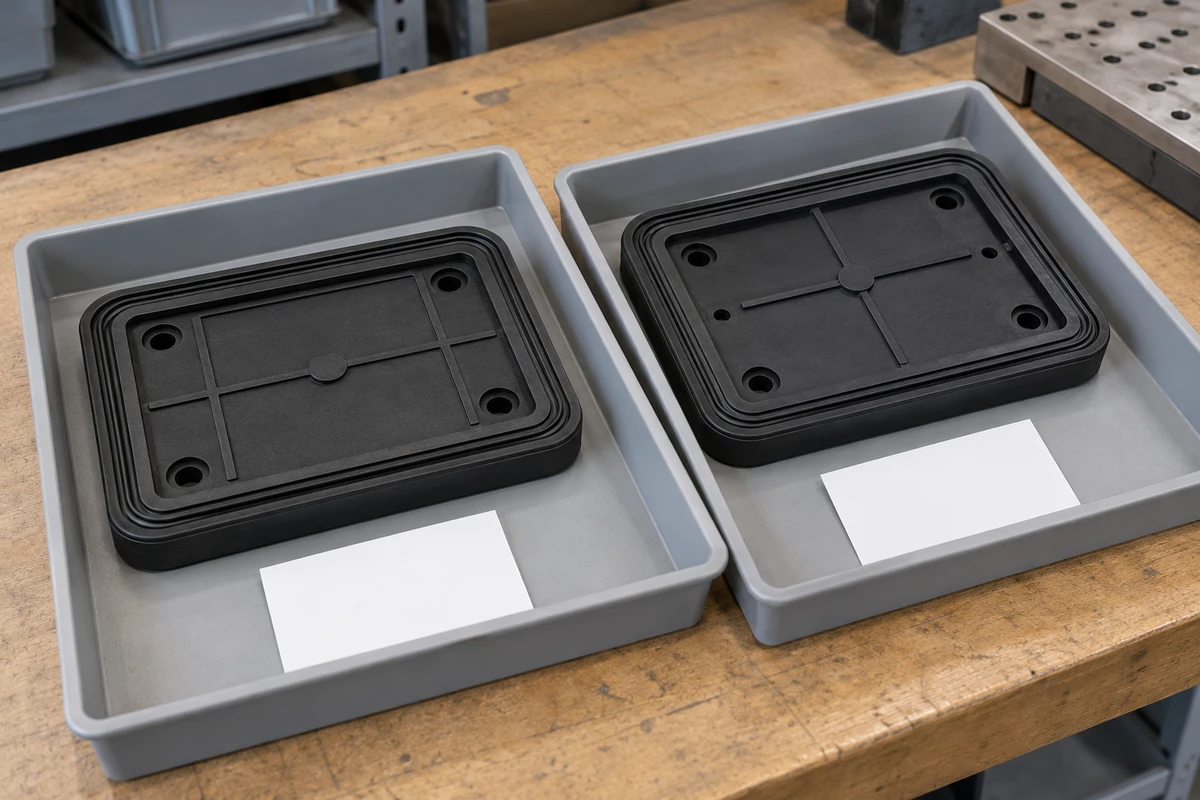
A stores description such as “140 × 115 vacuum plates” can hide more than one replacement item. Before ordering a replacement suction plate for a CNC vacuum pod, identify the installed vacuum-block system, the plate’s top or bottom position and the manufacturer’s complete article code. That connection determines which stock can cover which replenishment request.
The immediate buyer decision is whether several demands can use one documented spare or need separate purchase lines. Dimensions help identify candidates, but a common envelope should not erase distinct product identities. This article concerns bottom-plate replenishment; it does not specify holding force, vacuum settings or a replacement procedure.
Start at the block record, not the loose plate bin
Identify the machine or workholding installation and retrieve its vacuum-block family from the parts list, earlier purchase or applicable supplier record. Record which plate position the request concerns. A shorthand request for a “pod pad” may refer to a top suction plate, a bottom plate or another nearby component, so ask the requester to resolve the name against the product documentation.
Preserve the source of the identification. A machine’s original bill of materials may describe the blocks supplied then, while a later approved purchase may document a changed block family. Keep both records and ask which describes the installation now being replenished. Do not let a generic bin label become the only reference simply because it is easier to copy into the purchasing system.
Where the installed block remains uncertain, ask the machine provider or component manufacturer to identify the appropriate replacement from existing records and accessible identification images. A loose plate’s outline can support that inquiry, but should not be used to invent a complete code. No part removal or trial fitting is needed to frame the documentary question.
Equal dimensions can still leave two catalogue identities
Schmalz lists two bottom suction plates with a 140 mm length, 115 mm width and 16.5 mm height: VCSP-U 140x115x16.5 VCBL-K1 TPE, article 10.01.12.00228, and VCSP-U 140x115x16.5 VCBL-K2 TPE, article 10.01.12.00798. The listed envelopes coincide, while the complete designations and article numbers remain distinct. Schmalz bottom suction plates
This example shows why size alone is an incomplete stock identifier. It does not prove that the two articles are incompatible, nor establish that either is interchangeable with another plate. A decision to treat them as shared stock needs application-specific evidence covering the actual blocks and proposed replacement articles.
Keep both complete codes in a supplier inquiry until that evidence resolves the relationship. If a supplier proposes a common replacement, ask it to name the proposed article and provide the applicable manufacturer documentation or attributable confirmation for each covered application. The commercial convenience of one purchase line is a reason to ask the question, not an answer to it.
Separate physical stock from stock that covers demand
Start the replenishment review with three records: what each installation requires, which identified articles stores holds and which application relationships have been established. Physical count and demand coverage answer different questions. A count of rectangular plates does not establish the quantity available for a particular block family.
For traceable packages, retain the article number, complete designation, quantity and source record. For loose pieces with uncertain identity, retain the quantity as unresolved stock rather than allocating it to whichever demand is most urgent. This avoids both silently claiming coverage and automatically writing off items that further documentary identification might resolve.
A documented application approval may cover one replacement article for a particular installed system. Preserve those limits when calculating coverage. Approval for one machine does not automatically cover another installation with a similar-looking block, and a supplier’s answer for bottom plates should not be copied into top-plate records.
Use distinct statuses that a purchaser can act on: identified and covered by the applicable record, identified but application unresolved, or identity unresolved. These are inventory-planning descriptions, not technical inspection grades. Any condition or suitability assessment required for actual use belongs to the responsible technical provider.
Work through a fictional “one-size” stock line
Imagine a fictional workshop has grouped its spare bottom plates under “140 × 115 plates.” Earlier orders reveal both of the K-family designations in the Schmalz example, while current machine records list more than one block family. Some packages retain readable article labels and others have no traceable link to an order.
The purchaser first separates the documentary stock entries by identifiable article code. It keeps unresolved pieces visible without assigning them to either family. The open replenishment requests are then linked to their actual block records and bottom-plate position, instead of being combined into a single size-based demand.
Suppose the seller replies that it can supply only one of the two listed codes. That is an availability statement about its offer. Ask which requested applications the seller says that exact article covers and what manufacturer-supported evidence establishes the connection. Until that is answered, the offer should not reduce the apparent shortage on both family lines.
If an attributable response later supports a common article for a specified application, update that coverage relationship and its source. Preserve any application it does not address. If no common replacement is established, request separate exact-code offers or leave the unresolved line open. The example creates no real stock quantity, substitution approval or supplier commitment.
Make the quoted unit survive the next reorder
Once the required article is identified, ask the seller to state the exact code and complete designation in the quote. Include plate position and the relevant block reference so a shortened invoice description cannot easily detach the item from its use. Have proposed alternatives shown separately, with their evidence and approval status.
Request the selling unit and its contents. The buyer’s requirement may be counted as individual plates, while a commercial offer may describe a package or another unit. Do not assume pack contents from a photograph or carry a previous supplier’s package quantity into a new offer. Compare the current quoted quantity on the stated unit basis.
Keep price, available quantity and delivery terms tied to the actual offer date. A manufacturer’s catalogue entry identifies a product; it does not reserve stock for the buyer or prove that a marketplace seller can deliver it. If the exact code is unavailable, make the alternative or pending supply decision explicit rather than silently dropping the family suffix.
| Replenishment record | Why it matters |
|---|---|
| Installation and block family | Links demand to the documented system |
| Top or bottom position | Keeps distinct replacement positions separate |
| Full designation and article code | Preserves the actual item being purchased |
| Traceable stock by code | Shows the physical quantities whose identity is known |
| Application evidence and limits | Establishes which demands that stock can cover |
| Unresolved pieces or relationships | Prevents uncertain coverage from becoming a firm balance |
| Offered code, unit and quantity | Makes the current seller proposal comparable |
Close the stock record, then keep technical release separate
At receipt, connect the delivered package identifiers and counts to the accepted purchase line. If the label names another article, ask for resolution against the order before recording it as the approved replacement. Receipt photographs can document visible labels and contents; they do not establish sealing performance or workholding suitability.
Retain the accepted article-to-application relationship for the next reorder, together with any restrictions. When a block family changes, reopen the affected stock coverage rather than assuming every remaining plate still serves the new installation.
As an independent buying agent, we can collect exact supplier proposals and organize their purchasing evidence. See CNC workholding, then use the CNC quote request with a product link, a description or existing identification images. Technical documents need a separately authorized exchange. Installation and workholding assessment remain with qualified personnel under the applicable manufacturer’s instructions.
Frequently asked questions
Do equal plate dimensions establish interchangeability?
No. The cited Schmalz K1 and K2 bottom plates share listed envelope dimensions but have distinct complete designations and article codes. This does not itself prove incompatibility either; obtain evidence covering the proposed article and actual application.
Why identify whether the plate is top or bottom?
The purchasing request must name the replacement position shown in the applicable block documentation. A generic pod-pad description can leave the actual item unclear and should be resolved before selecting a quoted code.
How should unlabelled plates be counted?
Retain their physical quantity as identity unresolved. Do not allocate that quantity to a particular demand until the relevant identity and application relationship are established; further documentary identification may still resolve it.
What should a repeat suction-plate quote contain?
Request the exact article code, complete designation, plate position, covered block reference, selling unit and quantity. Keep availability and terms tied to the current seller offer, and show proposed alternatives separately.
Sources
Discuss a sourcing request related to this article.Reordering CNC Vacuum Pod Plates: Match the System, Not Just the Size