
Long CNC Linear Rails: Compare Freight Without Assuming They Can Be Cut
Compare an approved one-piece rail with a maker-defined jointed alternative only after its complete supply and technical review are clear.
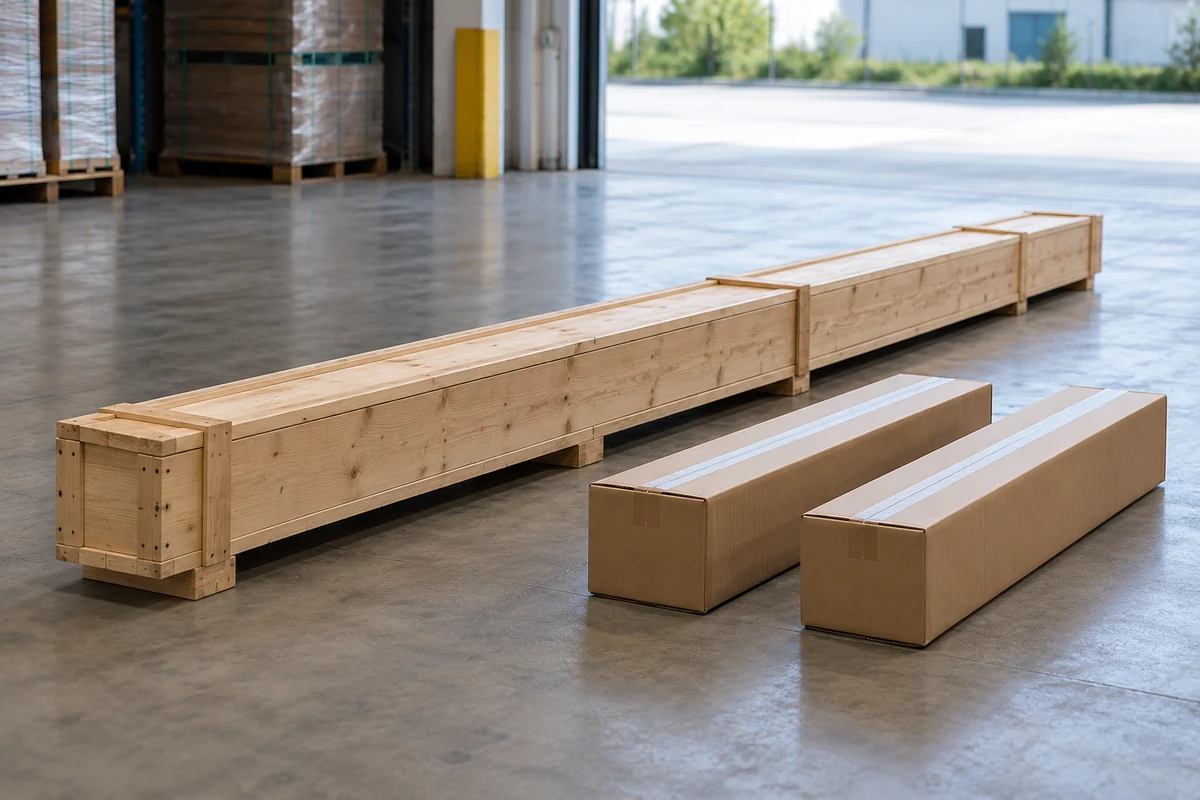
When shipping long CNC linear rails, compare freight only for product configurations the responsible technical reviewer can consider. A seller’s offer to shorten a finished rail to fit a parcel limit does not establish a manufacturer-supported jointed supply.
Begin with the approved one-piece requirement. If freight makes that proposal difficult, ask whether the maker offers a documented jointed alternative for the exact rail family and application. The alternative may change the purchased precision product as well as its package count, so it needs its own technical and commercial review.
Preserve the baseline rail requirement
Record the full rail code, required length, applicable specification, associated block scope and relevant machine or axis reference. Identify the source establishing a one-piece requirement, if there is one. An old order for a long rail is useful history but may not explain whether joints were excluded by the machine designer.
Ask the machine owner or its authorized technical provider which configuration can be reviewed. Do not change the length requirement to match a courier’s maximum. The carrier’s package limit and the machine’s guide requirement are different constraints.
This article starts after the replacement scope has been identified. It does not decide whether an existing block can be used on another rail. Keep any unresolved rail-and-block suitability question with that technical review rather than allowing a freight quote to settle it.
Ask whether a maker-defined alternative exists
THK’s HSR catalogue lists specification-dependent standard maximum lengths, discusses jointed rails for longer requirements and directs customers to THK when joints are not allowed. These are HSR catalogue statements, not universal maximum lengths or permission to cut another rail family. THK HSR catalogue, printed page A1-208
THK’s LM Guide manual also describes joint matching marks and coordinated relationships for jointed rails. The useful purchasing point is that a documented jointed product has defined relationships. It is not merely an assortment of shorter pieces with the same nominal size. THK LM Guide manual, section 3-4
For the actual offer, request the maker’s complete proposed configuration and its applicability to the required machine scope. The seller should identify the supplied segments, any coordinated guide relationships and the documentation that accompanies them. A generic catalogue paragraph is a reason to ask for this proposal, not evidence that the proposal already exists.
If the maker cannot support a jointed option for the requirement, retain the approved one-piece scope in the freight comparison. Do not create a supposedly equivalent option by asking a logistics provider to divide it.
Price the product change before the package change
Request separate commercial lines for the approved one-piece supply and any reviewable maker-defined alternative. Each should identify the complete deliverable, not just a rail price per unit of length. Preserve any change to the supplied set or associated items.
Have the responsible destination provider identify work or verification required by the alternative and quote its own scope where applicable. This is not a request for the purchaser to perform alignment or assembly. A lower freight offer is incomplete if it assumes destination work nobody has agreed to provide.
Technical acceptance may remain pending while a budget estimate is obtained. Mark it accordingly. Avoid ranking an unapproved alternative as the winner merely because the seller has supplied a shorter package dimension.
Once each option is sufficiently defined, ask its responsible packing provider for final or clearly provisional package lengths, counts and gross weights. The sum of nominal rail lengths is not a packing record. Request full-route freight on the same destination and service basis.
Use a configuration-first freight comparison
| Decision field | One-piece proposal | Maker-defined jointed proposal |
|---|---|---|
| Exact supply | Approved code, length and associated components | Maker proposal reference and complete segment scope |
| Machine requirement | Current approved basis | Reviewer response on the changed configuration |
| Product price | Actual scoped offer | Actual scoped alternative |
| Destination work | Existing agreed provider scope | Additional or changed scope, if required |
| Packed shipment | Provider’s dimensions, count and weights | Provider’s dimensions, count and weights |
| Freight | Accepted route and service boundary | Same boundary, separately accepted |
| Remaining dependency | Missing quote or confirmation | Technical, supply or transport condition still open |
This original worksheet deliberately puts the technical disposition before the shipping total. It does not prescribe how to join rails or promise that either option costs less.
Include quoted destination work in the decision, while keeping it distinguishable from freight. If one proposal has an unanswered work requirement, write the missing item beside its price. Treating that blank as zero would make the comparison appear more conclusive than the evidence allows.
A fictional courier-length shortcut
Imagine a fictional seller offers a one-piece replacement rail that matches an approved purchase specification. Its first courier enquiry cannot accommodate the proposed package. The seller suggests shortening the finished rail and sending the pieces together, without maker documentation.
The buyer declines that unsupported change and asks two different questions: what accepted transport arrangement is available for the one-piece supply, and whether the rail maker offers an appropriate jointed configuration for technical review. Neither answer is assumed.
Suppose a maker-defined alternative is later supplied with a complete configuration reference. The machine’s authorized reviewer still needs to assess it. The freight enquiry can describe that exact alternative provisionally, but it cannot turn an unanswered suitability question into approval.
If the reviewer accepts the alternative within a stated scope, the buyer compares its product offer, accepted freight and agreed destination work with the one-piece option. If the resulting total is not lower, or the destination scope is unsuitable, the alternative has not produced a demonstrated saving. No prices, lengths, timeframes or performance outcomes are represented in this example.
Make the purchase order describe the option actually chosen
Before release, connect the accepted configuration to the supplier’s final deliverables and the transport provider’s package basis. For a jointed supply, retain the maker’s documented component relationships in the order record. For a one-piece supply, preserve that requirement explicitly rather than relying on a sales image.
Refer later segment substitutions or changed rail scope to the technical owner before accepting an amended shipping plan. A complete package count does not prove that the delivered configuration is the approved one.
Our role as an independent buying agent is to organize the seller’s proposal and purchasing questions. Product engineering, rail installation and transport execution remain with their responsible providers. See CNC linear motion components for product context. Use the CNC quote request with a supported listing link, description or identification images. Up to five PNG, JPEG, WebP or GIF images are supported, at most 10 MiB each and 20 MiB total; drawings and manuals need a separately authorized exchange.
Frequently asked questions
Can linear rails be split just to reduce shipping cost?
A carrier length limit does not authorize changing the purchased rail. Preserve the approved requirement and ask the maker whether a supported alternative exists for the exact family and application. Keep an unsupported shortening proposal outside the usable freight comparison.
Are jointed linear rails the same as cutting a finished rail?
A maker-defined jointed supply has its own documented configuration and component relationships. Request that complete proposal and technical review rather than treating an arbitrary division as equivalent. The cited THK examples do not establish suitability for another family or machine.
What belongs in a long-rail freight comparison?
Include each exact supply configuration, technical disposition, product offer, provider-supplied package lengths and counts, accepted full-route freight and any quoted change to destination professional work. Mark provisional dimensions and unanswered work scope so a lower shipping line does not conceal an incomplete alternative.
Are jointed rails always cheaper to deliver?
No saving can be assumed. The complete product, freight and required destination scopes may differ, and an option that cannot satisfy the approved machine requirement is not a usable substitute. Compare the actual scoped offers only after the alternative has the necessary review.
Sources
Discuss a sourcing request related to this article.Long CNC Linear Rails: Compare Freight Without Assuming They Can Be Cut