
Describe the Material and Duty Before Requesting Extraction
Prepare material, process, contaminant and duty information so a competent provider can define a CNC extraction proposal and its limits.
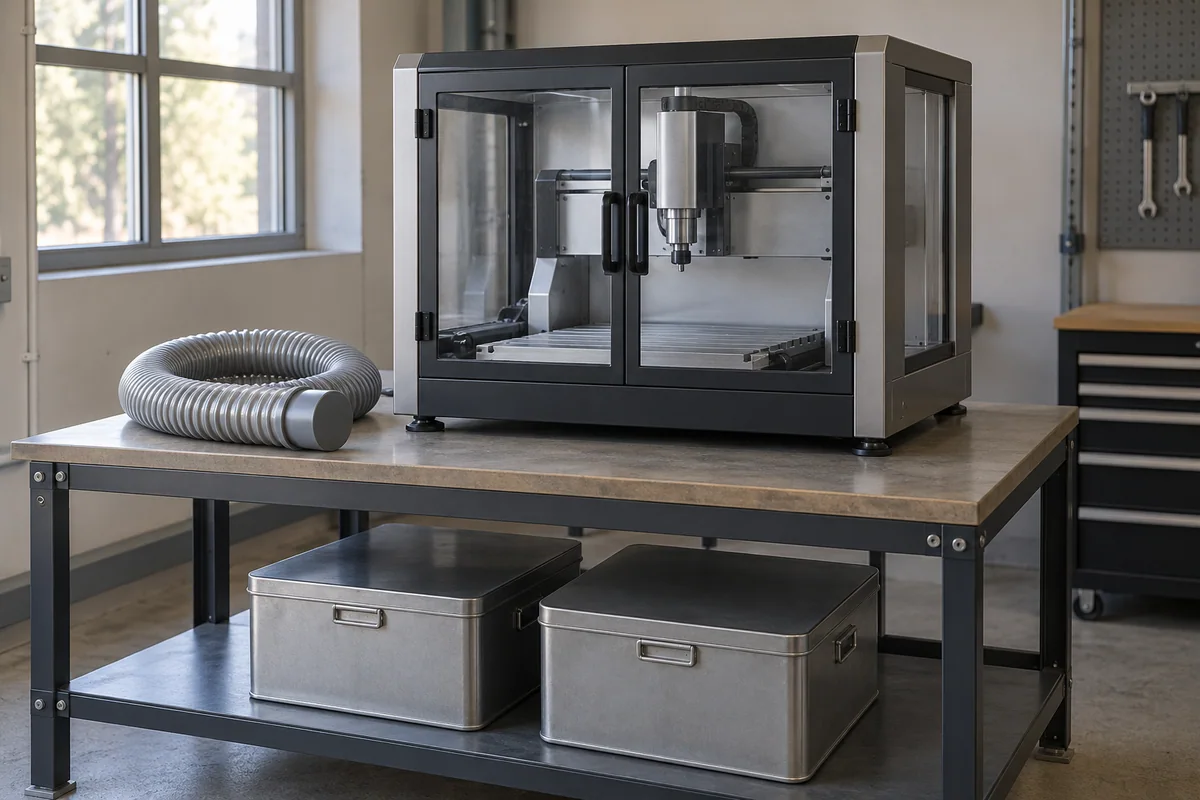
A CNC extraction request needs an application brief before it needs a collector model. Identify the actual materials, processes, possible airborne contaminants and intended duty, then ask a competent provider to define what it can assess and propose. A matching hose connection or an impressive catalogue airflow figure cannot answer that whole question.
The purchasing objective is to obtain a proposal with clear application limits and assigned technical responsibilities. This article does not calculate airflow, choose filtration, classify dust hazards or describe how to mix, collect or dispose of different materials. Those decisions require the actual application and qualified assessment.
Describe each process in its own right
List the CNC processes for which the buyer wants a proposal. Use the machine and material identities already known, and distinguish confirmed information from assumptions. “Small CNC workshop” tells a provider very little about what is generated or when. A description should make clear which activities the proposal must cover and which remain outside the current request.
For each material, provide its exact designation and available supplier safety information. Include known coatings, surface treatments, adhesives or other constituents relevant to the material description. If the composition is unknown, say so. Do not replace an unknown material with a convenient generic label simply to complete the RFQ.
Identify the relevant machine and its documented process or fluid requirements, where applicable. Do not invent a coolant method or assume that an extractor can make an unsupported machining process acceptable. The machinery and extraction reviews need consistent inputs, but the person collecting quotes should not design either system.
HSE’s G406 guidance says that a local exhaust ventilation (LEV) designer needs the process, the properties of the airborne contaminant, and information about how and where it is produced. This supports supplying an application description rather than selecting equipment from a connection size alone. The UK guidance is a technical reference here, not a finding about the buyer’s legal obligations in another location. HSE G406: information needed for LEV design.
Keep debris and airborne-emission questions separate
Tell the provider what is known about chips, dust, mist, fume or other emissions from the described process. Preserve uncertainty: “not yet characterized” is more useful than an unsupported statement that the process produces only harmless chips. Ask the provider what additional information or competent assessment is needed.
Do not make a hazard determination from the bulk material’s familiar name. OSHA explains that some materials that do not burn as larger pieces can become explosible as dust under appropriate conditions, and its examples include wood and metals. That background is a reason to obtain material- and process-specific review; it does not classify a particular buyer’s dust or authorize a collection method. OSHA combustible-dust overview.
Likewise, a clean-looking machine photo does not establish the absence of airborne exposure. Images can describe the equipment arrangement, but the purchasing record should leave exposure and hazard conclusions to the appropriate qualified people. Request the evidence they need instead of asking a seller for a reassuring visual demonstration.
Give duty a practical meaning
Describe the expected pattern of use: which machines may operate during the same period, which jobs alternate, and which proposed activities are only future possibilities. Supply the buyer’s real schedule or estimates with their uncertainty. Do not translate those descriptions into invented airflow or collection-capacity requirements.
A provider needs to know whether the proposal is intended for one identified process or several. Ask it to state which conditions its proposal covers and what changes would require reassessment. A quote for one machine should not silently become approval for a second connected source or a different material later.
Keep current scope and future options separate. If expansion is likely, ask the provider to identify what would have to be reviewed for that expansion. Avoid buying on a vague “future-proof” claim with no defined additional machines, materials or duty. An unassessed future use remains outside the approved basis.
Assemble an application brief that exposes unknowns
The following schedule helps a provider decide what information it has and what assessment remains. It is not a collector-sizing worksheet.
| Application record | Information to supply | Question for the competent provider |
|---|---|---|
| Material identity | Designation, supplier reference, known constituents and safety information | Is the information sufficient for the proposed assessment? |
| Process and machine | Exact machine, described activity and relevant manufacturer documents | Which emissions and machine requirements must the proposal address? |
| Contaminant information | Known dust, chip, mist or other characteristics, with unknowns labelled | What further characterization or specialist input is required? |
| Duty and concurrency | Actual or estimated use pattern and overlapping jobs | Which stated conditions will the proposal cover? |
| Collection interfaces | Machine port drawings and existing enclosure details where available | What interface information is missing? |
| Installation context | Intended location and relevant existing services or nearby activities | What site assessment and other parties are required? |
| Delivery boundary | Equipment sought and separately requested technical work | Who owns assessment, design, installation, commissioning and handover? |
Port information is useful to the inquiry, but do not treat a matching connection as a design conclusion. Ask the provider to identify the complete proposed arrangement and its limitations. Where another contractor owns part of the work, name that handoff before assuming the quotation is complete.
A fictional request covering wood and metal work
Imagine a buyer describes two CNC jobs: one involving a named wood product and another involving a named metal stock. The buyer asks whether one extractor can cover both because the machines have similar-looking ports. No real material, machine or collector is represented in this example.
The correct next step is to send separate process descriptions and ask a qualified provider to assess their scope and exclusions. Do not presume that one collector, common ducting or a shared waste stream is suitable. Do not invent a changeover, cleaning or segregation procedure to make the combined offer appear workable.
Suppose Offer A prices a collector but provides no written application assessment. Offer B responds only to the wood process and expressly leaves the metal process unanswered. A is incomplete for the application decision; B is a bounded proposal that may be reviewed for the wood process. Neither answers the entire original request.
The buyer can ask for the missing assessment or formally narrow the purchase to an approved scope. What it cannot reasonably do is compare the two prices as equivalent complete solutions. Retain the provider’s exclusions next to the quoted equipment so that an omitted process is not forgotten when the order is placed.
Specify the professional work being requested
Ask the provider to identify its experience with the described application and what review it proposes to carry out. Distinguish supplying a component from providing a designed and commissioned arrangement. If a listing seller cannot answer the application questions, involve the appropriate specialist rather than asking the sourcing agent to infer the answer.
HSE’s HSG258 publication covers deciding on, designing, commissioning and testing LEV, as well as competence and system documentation. Its scope is a useful reminder to define which of those stages the purchase actually includes. The existence of that guidance does not establish that an offered product or installation has completed them. HSE HSG258 overview.
Request the proposed handover deliverables and responsible parties: configuration documentation, applicable instructions, assessment or commissioning records within the agreed scope, and the basis for future review. A promise to provide technical documentation later should have a named owner and a clear decision point, not be marked as evidence already received.
Keep selection conditional on the application answer
Before accepting the equipment quote, reconcile the material/process brief with the provider’s stated coverage. Identify exclusions, unanswered conditions and dependencies on other parties. Ask the responsible reviewer to decide whether the evidence supports the intended purchase scope. Do not infer a filtration certification, exposure-control result or fire-safety conclusion from a product name.
Use the CNC dust-collection category to describe the equipment inquiry and the CNC quote form to send the listing or initial requirements. It permits up to five PNG, JPEG, WebP or GIF images, 10 MiB per file and 20 MiB total. Safety-data PDFs, CAD files and ZIP packs need a separately authorized exchange. The independent buying agent can coordinate sourcing and questions; a qualified provider must assess the actual extraction application.
Frequently asked questions
Can I select an extractor because its hose fits the CNC port?
No. Port compatibility is only one input. The provider still needs the material, process, contaminant, duty and site information to assess the intended application.
Can one collector handle wood and metal jobs?
Do not presume that it can. Present each actual process separately and obtain a qualified assessment of the proposed equipment, configuration and exclusions. This article supplies no mixing or changeover procedure.
What if I do not know the dust or mist characteristics?
Mark the information as unknown and ask the competent provider what additional characterization or specialist assessment is needed. Do not replace the gap with an unsupported harmlessness claim.
Does a collector quotation include design and commissioning?
Only if those services are expressly included with a defined scope and responsible party. Ask the provider to distinguish equipment supply, assessment, design, installation, commissioning and handover.
Sources
Discuss a sourcing request related to this article.Describe the Material and Duty Before Requesting Extraction