
Keep ER Collet Sets Organized When Consolidating Cased Kits
Keep ER series, exact bore designations and accessory locations clear when retaining or replacing the storage cases in a consolidated collet order.
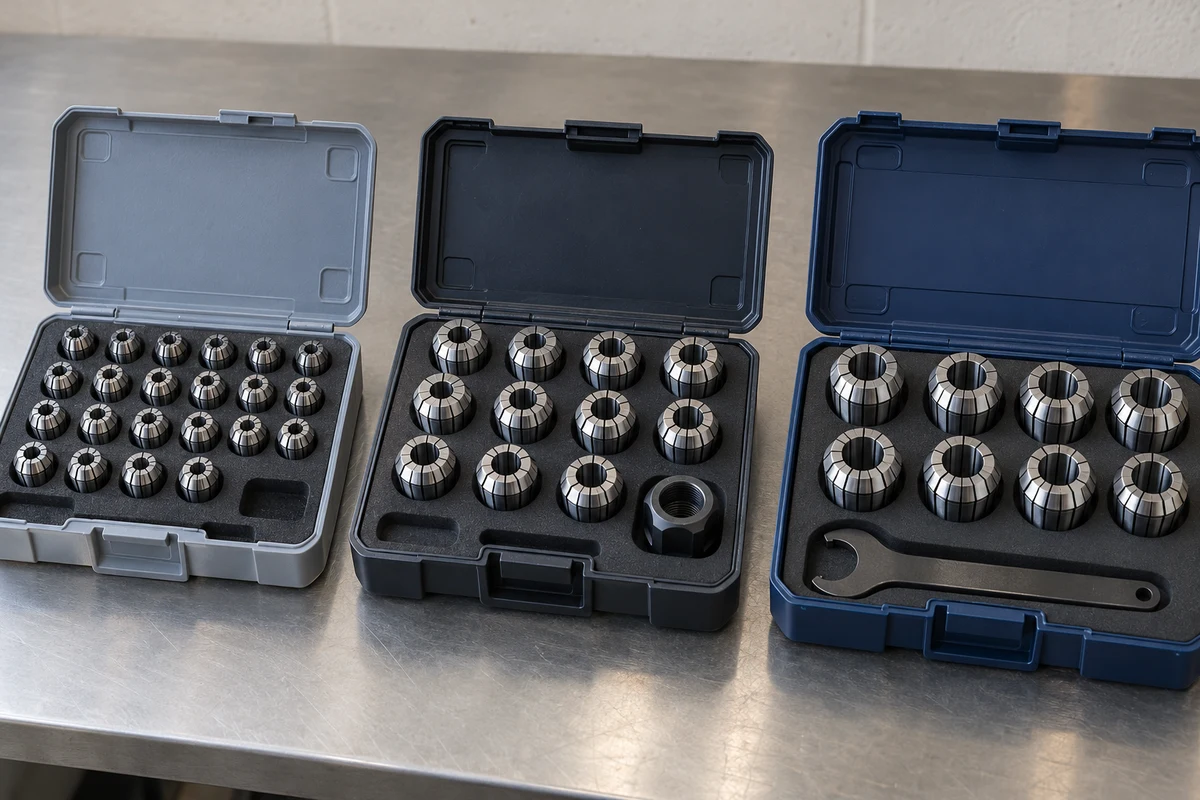
Collet set organizer packing should preserve the size assortment the buyer ordered. When several cased ER sets share a shipment, decide whether each supplied case will remain intact or whether a proposed replacement organizer will preserve the same series, bore designations and accessory locations. A correct total piece count can conceal a lost size map.
Start with already approved collet sets and their agreed contents. This is a packaging decision after tooling selection. The organizer record carries those accepted identities forward; it does not determine which collet, holder or nut is suitable for a machining application.
Read the case as a series and bore map
A supplied collet organizer can communicate more than where small metal parts sit. Its set reference identifies the purchased assortment, its series marking distinguishes an ER family, and its size markings identify the intended collet at each location. Record these layers together before comparing a consolidated packing proposal.
AMB’s ER16 set, SKU 98045335, illustrates the point. Its product page describes a transparent-lid plastic case with size markings and a milled foam insert. The listed contents are four collets designated 3 mm, 3.175 mm (1/8 inch), 6 mm and 6.35 mm (1/4 inch), plus one nut. The five-piece description therefore includes two different item roles. AMB ER16 cased set
For the actual purchase, preserve the approved designations as supplied, including any fractional and metric wording. A packing list that replaces all of them with “small collets” no longer describes the organizer the buyer accepted. Likewise, a replacement insert with five identical collet positions would not, by that description alone, account for the nut in this example.
Ask which markings belong to the supplied case and which will be reproduced in a proposed replacement. If a new location label is administrative, identify it as such. It should lead back to the approved set and item record rather than appear to be a new manufacturer designation.
Keep each ER set visible within a master purchase
One commercial master kit can contain several separately cased assortments. Haas Tooling’s 08-0005 description lists an ER16 set of ten collets, an ER25 set of fifteen and an ER32 set of eighteen, with a wrench for each size and an individual storage case for each set. Its advertised 46-piece total includes the three wrenches alongside 43 collets. The page also warns that actual accessories may vary, so confirm the contents of the specific offer. Haas ER collet master kit 08-0005
For packing review, retain a separate entry for each supplied set case even when the invoice has one master-kit line. Ask whether the proposal keeps all those cases, replaces some or replaces every case. “Master kit consolidated” does not answer that question.
Repeated bore designations must remain associated with their approved ER series. A list grouped only by bore can collapse different set entries into one heading. That documentary grouping does not establish that the collets are alternatives for the same application. Keep the series and full item identity visible without reopening the tooling decision through a packaging shortcut.
The buyer may accept one outer shipment containing the original cased sets. The buyer may instead consider a replacement organizer with clearly distinguished series sections. Either option needs an explicit description of what arrives, including whether the original cases remain deliverables. A single outer package does not require a single mixed organizer.
Distinguish an organizer offer from its contents
REGO-FIX’s current ER accessories index lists trays for collets, trays for inch collets and trays for DS/ER sealing disks separately. These are purpose-specific organizer categories; the index alone does not establish the contents or suitability of a proposed replacement tray. REGO-FIX ER accessories
When a supplier offers “an ER tray,” request the exact organizer reference and the proposed contents map. Ask whether its markings follow the ordered assortment, a different size sequence or an accessory arrangement. The name of the product family is not enough to approve how this order will be represented.
Keep tray capacity separate from purchased quantity. An unused location might belong to a broader organizer range, an excluded accessory or another supplier-confirmed purpose. Record that explanation against the exact offer. Do not describe every empty location as a missing collet, and do not add parts simply to make a photograph look complete.
The same distinction applies to nuts and wrenches. Identify their supplied locations separately from the collet sequence. If the new proposal moves an accessory outside its original case, show its new grouping in the record and ask the buyer whether that delivered arrangement is acceptable. No physical fit or protective claim follows from assigning a location on paper.
Compare a fictional two-case consolidation
Consider a fictional order with two already approved assortments. Set A is ER16 and contains collets designated 3 mm, 6 mm and 1/4 inch, plus one approved nut, in Case A. Set B is ER25 and contains collets designated 6 mm, 8 mm and 10 mm, plus one approved wrench, in Case B. These contents are invented for this purchasing example and do not describe an AMB, Haas or REGO-FIX offer.
The first packing proposal retains both cases within a common outer package. Its organizer decision is straightforward to describe: Set A keeps its existing size map and nut location; Set B keeps its own map and wrench location. The packing provider still needs to address the actual transport arrangement. Retaining cases closes only the delivered grouping question.
A second proposal replaces both cases with one tray whose headings are 3, 6, 8, 10 and 1/4 inch. The two 6 mm collets appear under one heading, the ER series are absent, and a note says “accessories included.” All six collets and both accessories may still be counted, but the proposal has not preserved the two series-specific assortments or explained the accessory locations.
Ask for a revised replacement map with a Set A / ER16 section and a Set B / ER25 section. Each section should retain its exact approved bore designations and item identities. The proposed nut location belongs to Set A’s contents record; the wrench location belongs to Set B’s. The map should also state whether Case A and Case B will be delivered separately or omitted subject to the buyer’s decision.
This revision is a request for a reviewable proposal, not an instruction to cut foam, transfer collets or select a tray. Before accepting replacement, obtain the responsible provider’s product-specific response on the proposed organizer and packing arrangement. If that response or the buyer’s case-retention decision remains missing, leave the replacement option open rather than marking consolidation approved.
Request one set-to-organizer record
Use the following fields to compare the supplied arrangement with the proposed delivery. This is an editorial purchasing worksheet, not a manufacturer’s packing specification.
| Record field | What the supplier should make explicit |
|---|---|
| Approved set and ER series | Full set reference and the series for each assortment |
| Collet contents | Approved item references, exact bore designations and original units |
| Supplied organizer | Case or tray reference, existing size markings and their source |
| Accessory positions | Nuts, wrenches and any other included accessories listed separately |
| Proposed change | Retain each case, replace its organizer or merge named sets |
| Replacement map | Series sections, exact item-to-location assignments and accessory locations |
| Unoccupied positions | Which positions are intentionally unused and the offer-specific explanation |
| Original case delivery | Which supplied cases remain included and the buyer’s decision on any omission |
| Provider response | Product-specific packing disposition, unresolved exceptions and responsible party |
Compare the proposed map against every approved set, rather than checking only the master-kit total. The useful questions are whether each series still has its own identifiable assortment, whether every listed bore retains its original designation and whether accessories have explicit homes. If the order changes, revise the affected set entry and map together.
Use existing supplier records and available package views to resolve discrepancies. A catalogue image may explain a general organizer arrangement, but it does not prove the delivered contents of this order. Where the offered case or marking scheme is unclear, request an attributable clarification instead of inferring it from an unrelated product photograph.
Close the organizer decision within its limits
Record the accepted case or tray references, delivered grouping and any replacement map revision. Preserve applicable individual protection in the proposal where required, and have the responsible provider address any change. A transparent lid, shaped insert or orderly size sequence supplies no independent evidence of transit performance.
The completed record should let the buyer answer a practical question: will the delivery preserve the accepted series-by-size assortments, or will it provide a specifically reviewed replacement arrangement? It does not certify collet condition, establish compatibility or approve the physical packing work.
For related purchasing categories, see CNC wear parts and CNC cutters and end mills. Start a CNC quote request with the selected set reference, a product description or supported listing link, and identify the case-retention question. Keep the requested delivered organizer arrangement explicit before accepting a consolidation proposal.
Frequently asked questions
Can several ER collet sets share one outer shipping package?
The packing proposal can retain separately identified cased sets within one outer shipment. Ask the responsible provider to address the transport arrangement and state whether every supplied set case remains included.
Can a replacement organizer group all collets by bore size alone?
Keep each approved ER series and set identity visible alongside the exact bore designation. A bore-only list can collapse separate assortment entries and leave the delivered grouping unclear. Request a series-specific replacement map for review.
Does a five-piece or 46-piece collet set contain that many collets?
Read the exact contents description. The cited AMB five-piece offer lists four collets and a nut; the cited Haas 46-piece description accounts for 43 collets and three wrenches. Confirm the actual offer rather than treating every piece as a collet.
Does an empty organizer position mean a collet is missing?
Compare the position with the approved contents and exact organizer offer. Record whether it is intentionally unused, reserved for an included accessory or unresolved. Tray capacity alone does not establish a purchased quantity.
Sources
Discuss a sourcing request related to this article.Keep ER Collet Sets Organized When Consolidating Cased Kits