
Specify Indexed Faces or Coordinated Rotary Motion
Separate indexed positioning from coordinated rotary motion, then ask who verifies the rotary, control and software combination for your job.
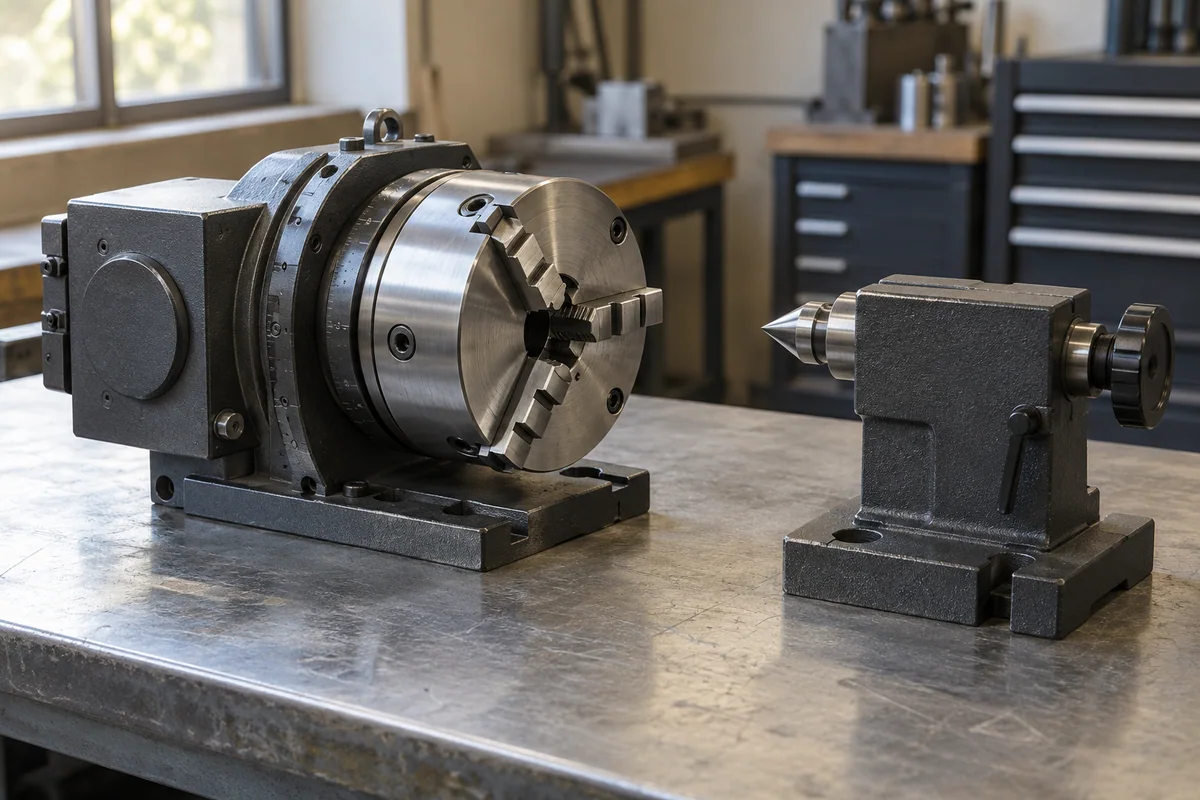
A fourth-axis package should be quoted against the motion the job requires. A rotary unit that presents another face between operations and a package that supports coordinated rotary motion during an operation answer different purchasing questions. The product name, a spare connector or a video of rotation does not establish which answer the offer provides.
Start with a feature requirement that a supplier and technical reviewer can discuss. Then ask which exact rotary, drive, control and software combination supports it. The aim is to buy a documented job mode, not to collect a fourth item on an axis-count list.
Describe the required result before naming the mode
Choose a representative part or feature group. State which features must be produced, how they relate to one another and what the buyer expects the rotary to contribute. Include the released part information and any already approved process requirement. If the process has not been selected, say so and ask the responsible programmer or integrator to classify the requirement.
For an indexed requirement, the RFQ can describe a proposal in which the part is presented at specified orientations for separate operations. For a coordinated-motion requirement, it should explicitly ask whether the proposed system supports the required rotary and linear motions under coordinated control. Do not use “continuous” alone when the seller might interpret it as the ability to rotate repeatedly.
A feature drawn around a cylinder does not, by itself, settle the machining strategy. Avoid claiming that every hole pattern needs only indexing or every curved feature requires a particular axis mode. The feature, process and complete system need a specific review.
A manufacturer example shows why the interface matters
Haas’s rotary manual distinguishes true simultaneous-axis control from its documented semi-fourth-axis arrangement. It states that the semi-fourth-axis arrangement cannot perform simultaneous interpolation with other axes. The same manual treats the mechanical head and its control as interfaced parts of the system. This is a bounded example of why the control method belongs in a rotary quote. It is not a compatibility statement for a different brand or controller. Haas rotary introduction.
Ask the proposed supplier to make the corresponding distinction for its own package. A response that says “four axes supported” without defining the requested job mode is incomplete. Ask for the exact documentation section and configuration that support the answer.
Allocate the motion question to the right people
The seller of a mechanical rotary may not be responsible for the host controller or CAM software. The buyer should identify who will bring those answers together rather than treating several unconnected “yes” replies as system approval.
| Purchase question | Evidence to request | Responsible response needed |
|---|---|---|
| What must the rotary achieve for this part? | Approved feature and process brief | Buyer’s programmer or process reviewer |
| Which rotary and drive are proposed? | Exact models, configuration and relevant manuals | Rotary/drive supplier |
| Does the host control support the requested mode with that package? | Model, revision, option scope and manufacturer confirmation | Control supplier or authorized integrator |
| Can the proposed CAM workflow generate the required supported motion? | Exact software, licensed function and post scope | CAM provider or responsible programmer |
| Who accepts the combined proposal? | Named technical owner and review scope | Buyer and responsible integrator |
This is a responsibility table for the motion decision. The controller handover folder, software recovery process and detailed post-delivery verification remain separate parts of the machine purchase. Likewise, physical rotary clearance requires its own setup review; a successful mode assessment does not establish fit on the table.
Make alternatives answer different requirements openly
If the supplier can offer an indexing package today and a different coordinated-motion package, request two clearly named alternatives. Each should state which of the buyer’s feature requirements it addresses, the exact components included and the unresolved technical dependencies.
Do not describe the indexing option as a cheaper equivalent unless the responsible process reviewer has confirmed an acceptable approach for the actual part. Conversely, do not add coordinated-motion scope simply because it sounds more capable. The buyer should know whether the extra scope is required now, optional for a defined future task or unsupported by the available evidence.
Where an option depends on a controller licence, upgrade or a different drive, ask for that dependency to be itemized. The quote should identify who supplies and supports it. Do not assume a later activation, firmware change or available connector resolves the requirement.
A fictional part with two separate motion decisions
Imagine a fictional buyer has two approved requirement descriptions. Feature group A needs several orientations for separate operations. Feature group B explicitly requires coordinated rotary-and-linear motion under the buyer’s proposed process. These are invented briefs for comparison, not instructions to machine a real part.
Offer A identifies a rotary and a standalone indexing control. It documents positioning between operations but provides no response to group B. Offer B names a rotary, drive and host-control combination and claims coordinated support, yet leaves the required CAM function unanswered.
Offer A may proceed to review for group A, but it has not answered group B. Ask whether the supplier proposes a separately documented alternative. Offer B has answered more of group B’s chain, but its software gap still needs an owner. A buyer should not combine Offer A’s hardware price with Offer B’s claimed capability and call the result a comparable package.
Now suppose the CAM provider confirms a supported workflow for B’s exact configuration. The technical owner can review the complete proposal and define the evidence needed to demonstrate the requested mode. This closes a named gap; it does not automatically establish part accuracy, safe operation or production readiness.
Ask for evidence that answers the mode question
Before commissioning any demonstration, have competent personnel agree what it must establish and which configuration will be used. The evidence should identify the rotary, drive, controller, relevant software and the representative requirement. A recorded demonstration with different equipment should be labelled as background, not acceptance of the quoted combination.
Ask the reviewer how the proposed evidence distinguishes coordinated control from independent motions that merely happen at the same time. The buying agent should not interpret a moving-axis video as proof of interpolation capability. Avoid requests for improvised wiring, bypassed safeguards or undocumented control changes.
Keep conclusions bounded. Documentation may establish that a function exists for a specified configuration. A scoped demonstration may establish what that configuration performed. Neither alone proves the complete part meets its dimensional requirements or that another configuration will behave identically.
Freeze the package around the chosen job mode
Once the responsible reviewer accepts a candidate, retain the exact motion requirement and component/software scope in the order. State which alternatives were excluded and which dependencies still need completion. If the supplier changes the controller or drive before dispatch, return the motion-support question to the technical owner.
A useful inquiry is: “Please assess the indexed and coordinated-motion requirements in our feature brief separately. Identify the exact rotary, drive, host control and software scope for each supported option. Cite the applicable documentation, name the integration owner and state every unresolved dependency. Do not treat physical rotation or an extra connector as confirmation of the required mode.”
Use the CNC rotary-axis category and CNC quote form to begin the sourcing request. We act as an independent buying agent; control integration and technical acceptance need an agreed responsible provider.
The initial form accepts up to five PNG, JPEG, WebP or GIF images, limited to 10 MiB each and 20 MiB total. Use a description or images to identify the task, then arrange an authorized separate exchange for native part files, PDFs and other technical documents.
Frequently asked questions
Does a fourth-axis connector prove coordinated machining support?
No. Ask for confirmation of the requested mode with the exact rotary, drive, controller configuration and software scope.
Is continuous rotation the same as coordinated interpolation?
The phrase is ambiguous. Ask the supplier to define it and confirm whether the required rotary and linear motions are supported under coordinated control.
Can I buy an indexer first and upgrade later?
Treat the later capability as a separate documented proposal. Do not assume that a future licence, controller change or drive addition is available or sufficient.
What should a supplier demonstration prove?
It should answer an agreed motion requirement on an identified configuration, with a competent reviewer interpreting the result. A rotating-axis video alone does not prove coordinated support, part accuracy or safe integration.
Sources
Discuss a sourcing request related to this article.Specify Indexed Faces or Coordinated Rotary Motion