
Check Whether a Damaged Guide End Plate Is an Orderable Spare
Use THK’s stated end-plate supply boundary to distinguish a component-only request from an assembly assessment, repair inquiry or reviewed replacement proposal.
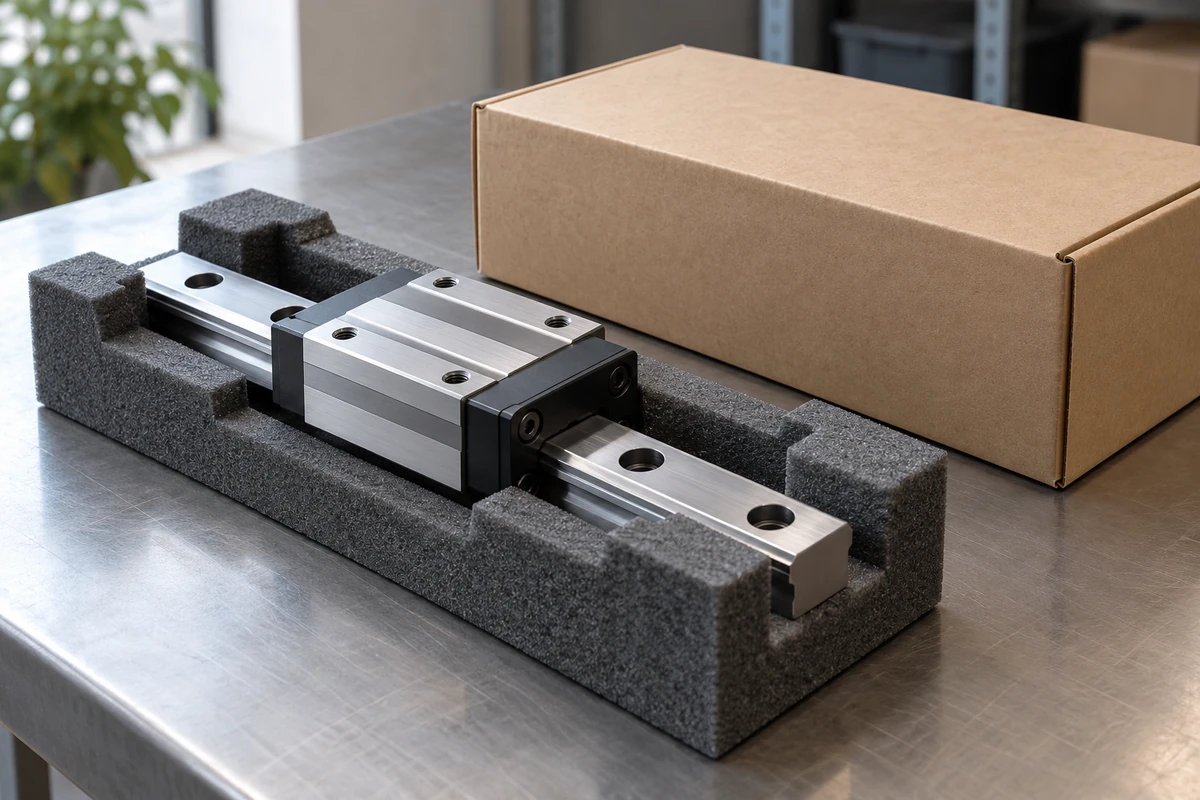
Before repeating an order for damaged guide end plates, check whether the manufacturer supplies them as separate spares. In its LM Guide FAQ about an end plate damaged after contacting a stopper, THK says end plates are not sold separately and directs a product-return repair request to THK. For that stated case, a component-only shopping request needs a different inquiry path. THK damaged-end-plate FAQ
Ask about the identified assembly and the actual assessment or repair offer before committing to a return or replacement. The FAQ is not an acceptance of a particular repair, a quotation or a prediction of downtime. This article concerns the available purchasing path; it does not diagnose damage, authorize service or give repair instructions.
Identify the assembly and preserve the reported event
Gather the guide manufacturer’s name, full assembly designation, machine reference and affected location from records already available. Link any accessible identification images to that assembly. The supplier needs to know which product the inquiry concerns rather than receiving only a close photograph of an unnamed damaged piece.
Retain the original description of the reported event and who supplied it. “Reported contact with a stop” and “cause confirmed by the service provider” have different evidential status. Do not turn a buyer’s observation into a diagnosis merely to match the manufacturer’s FAQ wording.
Distinguish the requested part from nearby components using the applicable product documentation or a manufacturer’s identification response. If the buyer calls an uncertain piece an end plate, preserve that uncertainty. A quotation for a similarly named cover is not an answer until its relationship to the identified guide is established.
Use existing records and safe accessible images. Do not remove a cover, seal or end plate to complete an inquiry. If further examination is needed, ask the appropriate technical provider to define that work and its authorization separately.
Check the standalone-sale boundary before seeking quantities
For the case addressed by the THK FAQ, the useful next commercial question concerns an assembly-related repair request. Repeating the requested number of loose end plates across more suppliers does not resolve the manufacturer’s stated supply boundary.
Ask the relevant contact whether the identified product and reported condition fall within that inquiry route, what information it needs and what scope it can actually offer. Preserve the responding organization and date. A referral to another contact is progress in locating an answer, but it is not confirmation that the item has been accepted for repair.
If a marketplace seller advertises a loose end plate, request its actual manufacturer, complete designation and basis for offering it for the identified guide. Keep that proposal distinct from a manufacturer-supported route. Its title or photograph does not establish provenance, suitability or an exception to the cited policy.
The buyer may ultimately receive an assessment proposal, a repair offer, a replacement alternative or a response that more information is needed. Record the actual answer without manufacturing a service capability or assuming that every returned assembly will be repairable.
Keep three possible proposals distinguishable
An assessment proposal should describe what the provider will evaluate and what record it will return. Ask whether its scope includes a later repair quotation or only an assessment result. A request to examine the assembly should not become an open-ended permission to carry out work.
A repair quotation should identify the assembly, offered deliverable, provider and stated exclusions. Preserve actual charges and timing only when supplied, including conditions that could change them. “Contact us for repair” leaves all of these commercial details unanswered.
A replacement proposal should identify the full supplied scope. Replacing a block, a rail-and-block assembly or a larger coordinated group involves different purchasing questions. Have the appropriate technical reviewer establish the required alternative; do not choose one merely because the loose end plate is unavailable.
This article does not compare repair economics or set the service authorization. Its endpoint is a correctly framed inquiry that gives the buyer those real proposals to consider. The later decisions should use the provider’s actual offer and the buyer’s technical and commercial authority.
| Inquiry field | Record to obtain | Assumption to avoid |
|---|---|---|
| Guide identity | Exact assembly and relevant machine location | A damaged-part image identifies every option |
| Reported concern | Existing observation, source and supporting images | The cause has already been diagnosed |
| Separate-spare policy | Applicable manufacturer statement or response | Every visible component is separately orderable |
| Assessment or repair | Actual provider offer, deliverable and exclusions | A referral means repair has been accepted |
| Replacement alternative | Identified supply scope for technical review | A new block automatically suits the old rail |
| Commercial limits | Actual cost, timing and any unresolved conditions | Unknown charges are zero or service is immediate |
Keep seal questions within the same assembly inquiry
A seller may suggest buying seals or another surrounding accessory instead. Preserve that as a separate proposed change within the existing case, with an explanation of what requirement it is meant to address. An accessory proposal does not by itself answer whether the reported end-plate damage can be resolved.
THK’s seal FAQ describes model-dependent connections between end seals and end plates and directs relevant removal questions to THK. It supports keeping these questions with the identified assembly and manufacturer, rather than treating every seal as an independent do-it-yourself spare. No removal or attachment steps are reproduced here. THK end- and side-seal FAQ
Ask the provider to identify any accessory included in its actual offer and whether it changes the assessment or replacement scope. Do not open another generic spare-parts order to bypass an unanswered assembly question. Any approved scope must come from the appropriate parties, not from the size or apparent simplicity of the loose component.
Work through a fictional request for ten end plates
Imagine a fictional buyer asks for ten replacement end plates after reported contact events on identified guide assemblies. The count describes the buyer’s request; it does not establish ten separately orderable spares, ten repairable assemblies or a confirmed cause. No real equipment or service offer is represented.
The coordinator connects the reports to their assembly references and checks the applicable manufacturer policy. Where the cited THK case applies, the next request asks for the available assessment or repair route for those assemblies. The inquiry retains any incomplete identity or condition records rather than presenting all ten as one fully characterized problem.
Suppose the responding contact asks for more identification information and says an assessment offer may follow. The buyer now has a documentation request, not a repair booking. It would be premature to promise a return date, procure loose substitute plates or count repaired assemblies as future available stock.
If a later response proposes replacing one identified assembly, preserve that narrower outcome. Request the exact replacement scope and its required review. The remaining reports keep their own status; one proposal cannot be multiplied across the other nine without the relevant evidence.
Finish with a real supply or service question
Before the buyer decides, record whether the inquiry seeks a defined assessment, a specific repair offer or a reviewed replacement alternative. Retain any unresolved item identity, provider acceptance, cost or timing. Arrange a physical return only after the relevant parties have agreed its scope and instructions; this article supplies no packing, dismantling or shipping procedure.
The machine’s underlying problem remains with the responsible technical personnel. A component purchase or completed commercial service record does not establish the cause of the event or authorize the machine’s return to use.
Our independent buying-agent role is to collect supplier answers and make the available proposals clear. See CNC linear-motion components for category context. Start the CNC quote request with a supported marketplace link, description or existing relevant images.
Image attachments support up to five PNG, JPEG, WebP or GIF files, at most 10 MiB each and 20 MiB total. The form does not accept CAD, PDF or ZIP files. Drawings and service records need a separately authorized file exchange.
Frequently asked questions
Does THK sell the end plate separately in the cited damage case?
THK’s LM Guide FAQ says the end plates addressed there are not sold separately and directs a product-return repair request to THK. Confirm how that statement applies to the identified assembly.
Does a repair inquiry mean the manufacturer will accept the assembly?
No acceptance, price or turnaround follows from sending an inquiry. Obtain the actual provider response and proposed scope before arranging a return or relying on an expected repair.
Can I order a seal instead of resolving the end-plate question?
Ask what the proposed seal would address and how it relates to the identified assembly. THK’s seal FAQ describes model-dependent end-seal/end-plate connections; an accessory listing does not establish a remedy or permission to remove parts.
Should unavailable end plates lead straight to a complete guide order?
Request a defined replacement alternative if appropriate, then have its exact scope technically reviewed. The missing loose-spare option does not by itself determine whether a block, assembly or larger replacement is required.
Sources
Discuss a sourcing request related to this article.Check Whether a Damaged Guide End Plate Is an Orderable Spare