
Verify the Delivered Cutter Grade and Coating Claim
Resolve the delivered cutter’s manufacturer grade, substrate and coating designation without using a gold surface or a broad coating label as identity proof.
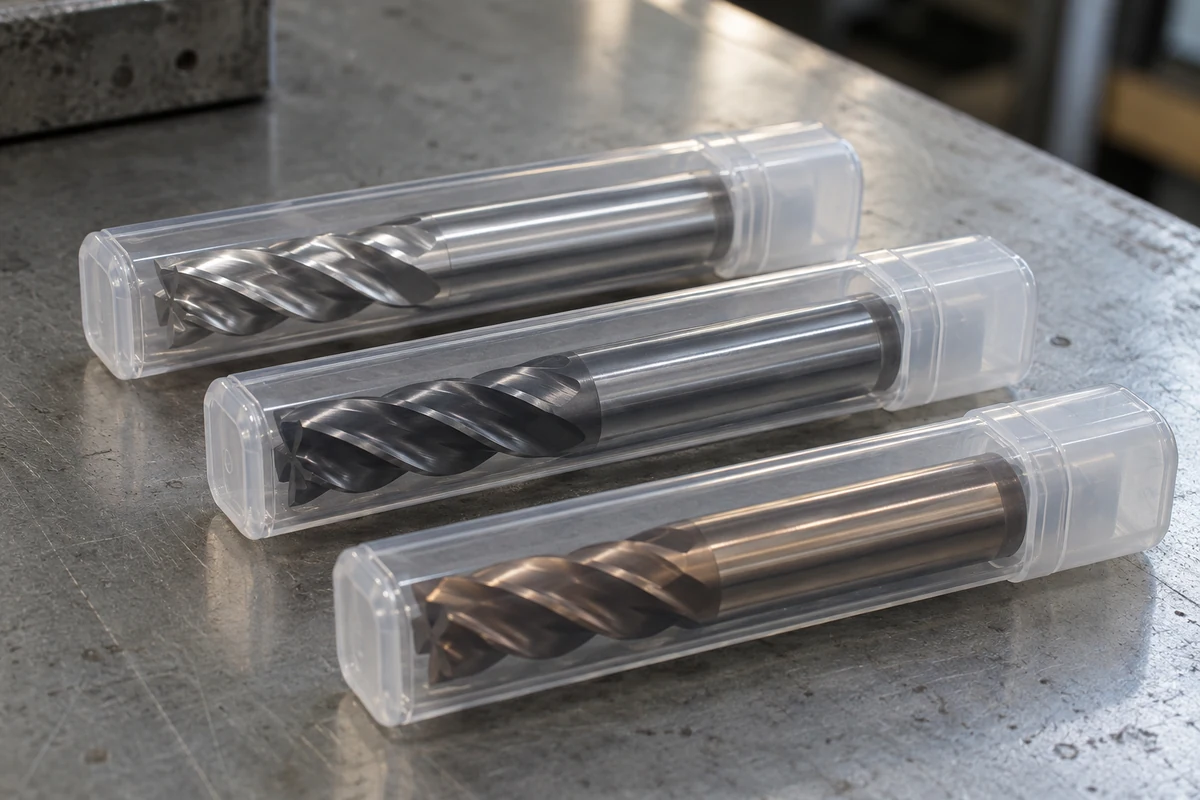
To verify a delivered cutter’s grade or coating claim, compare the complete manufacturer designation with the approved tool, then ask what that designation actually specifies. A gold-colored surface and a package saying “coated carbide” leave several different questions unresolved: which substrate, which coating system, which tool variant and whether an alternative was supplied.
The buyer’s decision is identity acceptance for the ordered cutting tool. It is not a coating-selection guide, a chemical analysis or a promise of tool life. Keep the original approved requirement visible while the supplier explains any mismatch.
A grade can describe more than the surface layer
Sandvik Coromant explains that coated cemented carbide combines a carbide substrate with a coating to form an application-specific grade. Its material discussion also identifies carbide grain size and binder composition as variables affecting grade properties. Accordingly, a matching coating name alone does not answer which substrate-and-coating grade was delivered. Sandvik Coromant cutting-tool materials
Separate three entries in the receiving record: the full toolmaker order code, the maker’s stated substrate or grade designation, and the stated coating designation. Preserve the source wording. If the maker does not disclose the substrate formulation, record that limitation and retain the controlled commercial grade; do not fill the gap with an assumed carbide recipe.
Ask whether the approved order specified an exact branded grade or a broader requirement that permits an alternative. Those are different acceptance baselines. A supplier cannot establish equivalence merely by repeating “solid carbide,” but the buyer also should not invent a proprietary-grade requirement that was never part of the order.
Distinguish coating chemistry, process and commercial designation
The same Sandvik reference distinguishes chemical vapor deposition, CVD, from physical vapor deposition, PVD, and discusses multilayer coating structures. These terms identify process families or constructions; they do not replace the exact toolmaker grade. A reply that changes an approved designation to “PVD coated” has become less specific, even if that statement is true. Sandvik’s coating discussion
Keep the chemical shorthand exactly as the applicable manufacturer uses it. Do not normalize two similar-looking names into one term to make a comparison sheet tidy. Ask the manufacturer or responsible tooling reviewer whether a seller’s abbreviation refers to the ordered product, another product in the family or a proposed substitute.
A commercial name can also identify a particular supplier’s coating system rather than a universal material specification. Request its official product reference and the tool code to which it applies. Generic search results about a similarly named coating cannot establish that this delivered cutter received that system.
When the order specifies only a broad coating category, the reviewer may need to clarify the intended evidence now. Keep that clarification separate from a claim that the original order included undisclosed thickness, layer structure or performance criteria. Receiving should expose ambiguity, not silently rewrite the purchase.
Use a real color comparison to see the limitation
Harvey Tool lists titanium nitride, TiN, with suffix -C1 and a gold color description. On the same page, zirconium nitride, ZrN, has suffix -C7 and a light-gold/champagne description. The chemistry and maker designation differ even though both descriptions are gold-related. These are Harvey-specific designations, not a decoding system for other brands. Harvey Tool coating descriptions
The receiving inference is narrow: “looks gold” cannot select between those documented identities or authenticate an unnamed cutter. A photograph may record an apparent surface difference worth querying, but it is not a chemical assay. Likewise, the expected-looking color does not close a missing product-code or substitution question.
Do not convert the maker’s color descriptions into a visual sorting test for mixed tools. If individually packaged tools have been repacked under a generic seller label, ask for the attributable identification records or an authorized assessment. Preserve which tools can be identified and which remain unresolved.
Read the complete code before accepting a shortened label
Compare the order code character by character with the accessible manufacturer marking and package label. Where the seller uses its own SKU, ask for its mapping to the original maker code. Keep both identities rather than replacing the manufacturer’s designation with the marketplace title.
A suffix may matter, but its meaning must come from the maker’s documentation. Do not assume that every suffix identifies a coating or that an omitted suffix means “uncoated.” The supplier should explain the exact difference using the relevant code structure. Record any changed geometry separately so a coating explanation cannot conceal a different tool form.
| Identity question | Evidence that answers it | Incomplete substitute |
|---|---|---|
| Which cutter variant was ordered? | Complete approved toolmaker code | A family photograph |
| Which grade or substrate is stated? | Maker’s applicable designation and documentation | “Premium carbide” |
| Which coating is claimed? | Exact named system and applicable tool code | “Gold PVD” |
| What arrived under that identity? | Accessible marking, package and attributable supplier mapping | An unrelated catalogue screenshot |
| Was anything changed? | Explicit substitute code and difference statement | “Same quality” |
| Who accepts the result? | Buyer-authorized technical disposition | An unreviewed seller assurance |
This original editorial comparison sheet organizes the receiving decision. It is not a certification scheme, a compulsory document list for every cutter purchase or a procedure for laboratory testing.
Work through a fictional gold-tool substitution
Imagine an invented order for six cutters from one named maker, each with an approved TiN-coated order code. Four arrive in individually identified packages matching that code. Two arrive in seller-labelled sleeves saying only “gold coated carbide.” All quantities and receipt events in this case are fictional; it is not a report about Harvey, Sandvik or any real supplier.
The buyer records the four code matches as documentary matches subject to the remaining agreed checks. The two generic sleeves remain unresolved. Their similar color does not establish either the coating chemistry or the underlying grade. Nor does it show that they are counterfeit; the evidence simply does not identify them sufficiently.
The supplier then provides a different maker’s ZrN-coated code for those two tools and calls them an upgrade. That reply resolves part of their claimed identity but discloses a substitution. It does not turn the original TiN requirement into a fulfilled line. The buyer needs the alternative’s own substrate/grade and tool documentation, followed by a responsible decision on whether the substitution is acceptable.
If the buyer declines the alternative, follow the agreed commercial remedy. If the buyer considers accepting it, record the exact two tools, changed designation, supporting documents and named approval. Do not relabel them with the original code or allow the exception to silently authorize later substitutions.
Finally, suppose the supplier cannot connect its alternative code to those particular sleeves. The substitution remains a proposal without an adequate delivered-item link. Keep that identity gap visible even if the technical reviewer considers the proposed alternative suitable in principle.
Escalate unresolved material identity deliberately
Some purchases may need evidence beyond catalogue and package identification. Have the responsible specialist specify the actual question, appropriate evidence and any separately authorized laboratory work. A general certificate headed “carbide” may answer neither coating identity nor the agreed grade requirement; its title alone is insufficient.
This article offers no scratch test, chemical test, destructive sample preparation or improvised hardness check. If additional verification is commissioned, distinguish what it can establish about substrate, coating, layers or the sampled population. The chosen provider must state the method’s limits and how its results relate to the buyer’s requirement.
Close the record with the identity accepted, the exact scope covered and any unresolved substitution. Documented identity does not itself prove that the tool meets every dimensional requirement or will achieve a promised production life.
As an independent buying agent, we can collect the seller’s exact proposal and organize its supporting documents. Explore CNC cutters and end mills, then start a CNC quote request with the product link and known designation. The form accepts up to five PNG, JPEG, WebP or GIF images, at most 10 MiB each and 20 MiB total; arrange PDFs or other technical files separately through an authorized exchange.
Frequently asked questions
Does a gold surface prove that a cutter has TiN coating?
No. Harvey Tool documents TiN and ZrN with different designations and gold-related color descriptions. Use the exact maker designation and attributable delivered-item evidence; color is not chemical identification.
Is a matching coating enough to confirm the ordered grade?
Not where the requirement includes a particular grade. A coated carbide grade can combine substrate and coating characteristics, so retain the maker’s complete designation.
Can I compare coating suffixes across brands?
Only with each manufacturer’s documentation. A suffix belongs to its maker’s code system; the same characters or a missing suffix cannot be decoded universally.
What if the supplier calls another coating an upgrade?
Treat it as a proposed substitution. Obtain its exact tool and grade documentation and keep buyer approval, affected quantity and the original requirement explicit.
Sources
Discuss a sourcing request related to this article.Verify the Delivered Cutter Grade and Coating Claim